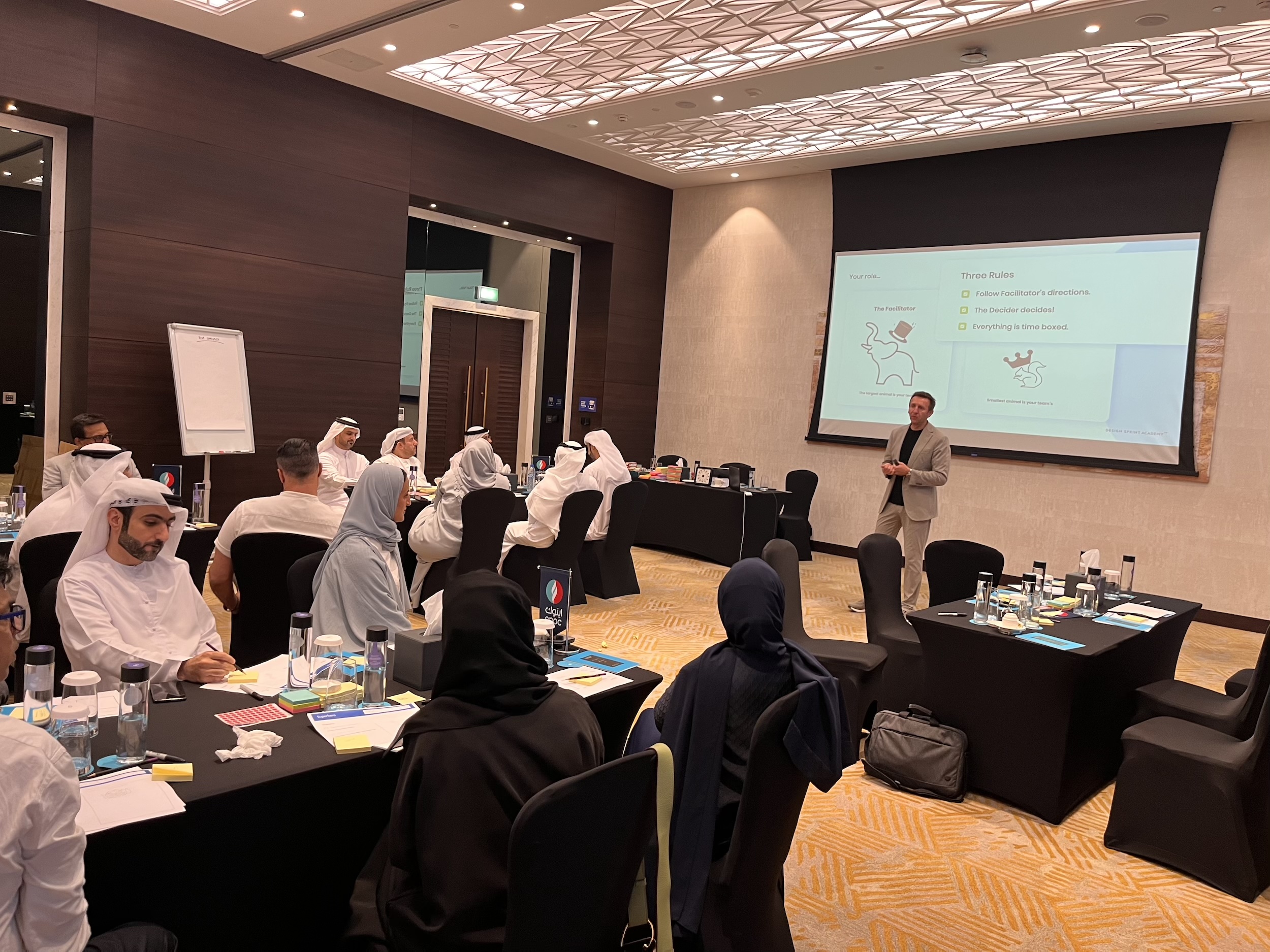
ENOC Dubai — Design Sprint training for senior leaders in the energy sector

ENOC and the context that makes this engagement specific
Emirates National Oil Company is one of the UAE’s largest integrated energy companies, operating across fuel retail, aviation fueling, industrial products, lubricants, distribution, and group health, safety, and sustainability functions. Its operations span the length of how energy moves through the UAE economy — from refining and storage through to the petrol stations, airport fueling depots, and commercial clients that represent the customer-facing end of the business.
ENOC is also an organization navigating a specific kind of tension that most large energy companies share: the operational excellence culture that makes it reliable and safe — rigorous process, clear hierarchy, defined accountability — is not the culture that naturally generates the cross-functional collaboration and iterative problem-solving that new challenges require. Departments are organized for performance within their own domain. Working toward the benefit of another department, or questioning an established process, or proposing an untested solution direction, requires a different kind of structure than daily operations provide.
That's the environment into which Design Sprint training was brought on September 2023.
The room: who was in it and why that matters
Up to 24 senior leaders attended, drawn from across ENOC's major divisions.
The participant profile is worth noting, because it changes the nature of what the training produced. This wasn't a group of innovation enthusiasts or UX practitioners self-selecting into a methodology program. It was a cross-section of the people who run significant parts of ENOC's business: Directors and Senior Managers from commercial, retail, and industrial divisions; operations leaders from aviation fueling and distribution; sustainability and HSE managers; and innovation and quality specialists from corporate functions.
The room spanned ENOC's full operational breadth — from customer-facing retail to industrial supply chains to safety and sustainability — at a level of seniority where the people present own the challenges they work on.
The format: Design Sprint Training adapted for a senior audience
The Design Sprint Training program was customized for the seniority and context of the ENOC audience. The goal was not to produce sprint outputs as formal organizational deliverables, but to give participants a direct, hands-on understanding of how the Design Sprint process works — what it produces, what it requires, and how to recognize good sprint work when they see it.
The day ran across two halves. The morning covered the foundations: what a Design Sprint is, what conditions make one successful, picking a sprint challenge, and defining the target customer. The afternoon went deeper into the process: defining the sprint direction, picking a target, and sketching solutions. The day closed with an introduction to prototyping and testing in a sprint — taught through examples and case studies from other organizations we’ve worked with: Redbull, Adidas, SAP, etc.
Participants worked in three teams throughout, each using a real challenge from their own organizational context as the training material. That grounding made the learning concrete: the Proto-Personas reflected real users, the Customer Journey Maps reflected real experience gaps, the Long-Term Goals and Sprint Questions reflected real strategic questions. The challenges were vehicles for understanding the methodology — not initiatives being formally advanced — but because the content was genuine, the thinking the exercises produced was genuine too.
Three teams, three real challenges
The challenges the teams chose to work on are the most revealing part of this engagement. They were not assigned. Each team brainstormed problems from their actual work and selected the one most worth spending the day on.
What they chose spanned the full range of challenges a large integrated energy company navigates: organizational challenges about how divisions with different performance mandates collaborate toward shared goals; commercial challenges about how to grow revenue and market share at specific points in the business; and operational challenges about how the frontline service experience can be improved for both the people delivering it and the customers receiving it.
That breadth is significant. Design Sprint methodology is often associated with product and technology teams working on customer-facing innovation. The ENOC engagement demonstrated something different: the same structured thinking applies equally to the internal organizational tensions, commercial performance questions, and operational efficiency problems that senior leaders in any large industrial company are navigating every day.
What the day produced
Three teams worked through the upstream sprint exercises using real ENOC challenges. Each team left with three concrete outputs: a Long-Term Goal, a set of Sprint Questions, and a clearer shared understanding of what the challenge actually was — which is not always the same as how it was initially described.
Across all three teams, a consistent pattern emerged. The sprint structure surfaced the assumptions embedded in each challenge — the things teams had been treating as fixed that were actually questions worth testing. It also named the obstacles that would need to be addressed for any initiative to succeed: questions about organizational resistance, about whether the right stakeholders were aligned, about whether the proposed direction would actually land with the people it was meant to serve.
For senior leaders, this is where the method's value is most concentrated. Most organizational initiatives fail not because the goal is wrong but because the obstacles were never explicitly named before execution began. The sprint structure makes that naming a required step, not an optional one. A leadership team that has articulated its Sprint Questions before handing a challenge to an execution team is in a fundamentally different position from one that discovers those questions mid-delivery.
The sprint structure also consistently reframed challenges from the form in which they were first described. What arrived as an operational problem often revealed a user experience question underneath it. What arrived as a commercial performance challenge often turned out to hinge on a customer or employee behavior that hadn't been clearly defined. That reframing — from symptom to underlying question — is the direction-setting work that determines whether everything the sprint team builds afterward is working on the right thing.
For all three teams, the closing portion of the day — prototyping and testing in a sprint — was introduced through real case studies from other organizations. Participants saw what that phase produces and how it connects to the upstream work they had just done hands-on, completing their understanding of the full sprint arc.
Why the energy sector needs this methodology now
ENOC operates in a sector that is simultaneously one of the most stable in terms of established infrastructure and one of the most structurally disrupted in terms of long-term direction. The energy transition is changing what fuel retail, aviation fueling, and industrial energy supply need to look like over the next decade. At the same time, the operational demands of running safe, reliable energy infrastructure require the kind of rigorous process and clear accountability that doesn’t naturally flex toward experimentation.
The fact that the CSR and sustainability function sat alongside operations, commercial, and marketing leaders in a design sprint reflects an organizational recognition that the challenges ahead can't be solved from within any single function. They require the kind of cross-functional, structured problem-solving that Design Sprints are built to produce.
The three challenges the ENOC teams chose — organizational alignment, commercial performance, and operational efficiency — span exactly the range of problem types that energy companies face in a transition period: how to make the organization work together better, how to grow revenue from the current business model, and how to make the frontline operation more effective. None of these are innovation problems in the sense of requiring new technology. All of them are decision-making problems that require the right people in the same room with a structured process for defining what to work on and how to test it.
That’s what Design Sprint training equips an organization to do — not to become an innovation lab, but to make better decisions about the real challenges already on the agenda.