Five reasons teams need an AI Facilitator (and what each one looks like in practice)

Why this role is emerging now
Most organizations are in what looks like the teenage phase of AI adoption. Lots of activity. Plenty of confidence. Limited direction. Pilots starting in different teams without anyone tracking them. Workflows being redesigned in one corner of the business while another corner is still figuring out what AI even means for their work. And underneath all of it, the same organizational issues that have always been there — misalignment, siloed decision-making, vague mandates, slow learning — amplified by AI's pace.
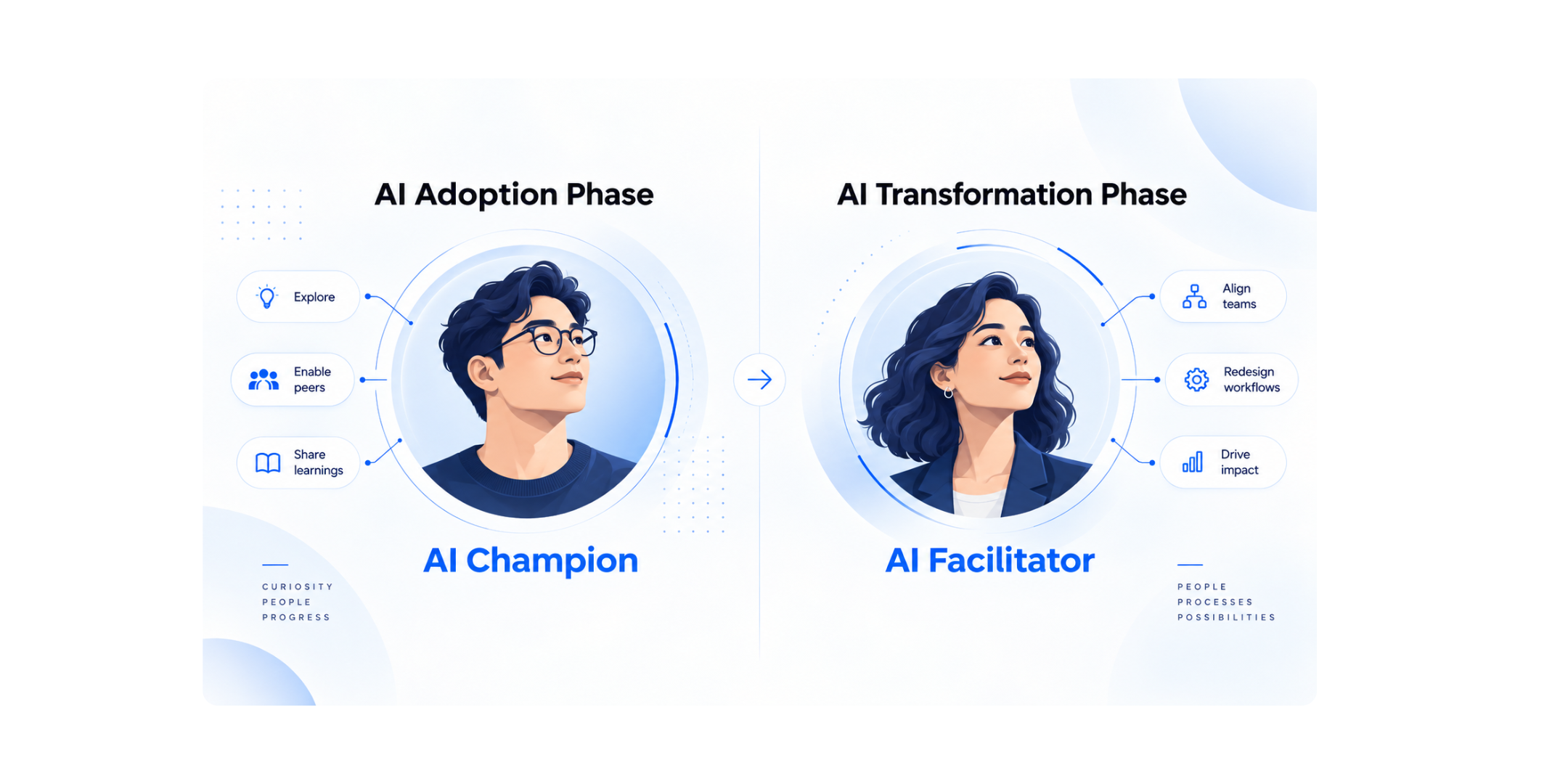
The AI facilitator is the role that addresses this. Not as a workshop runner. Not as a coach. As what we have started calling a clarity-builder — someone who helps teams make confident decisions about AI by bringing the right people together at the right time and using structured methods to surface what would otherwise stay buried.
This article walks through five concrete reasons teams need an AI facilitator. Each one is a pattern most facilitators will recognize from their own work. Together they make a clearer case for the role than any abstract definition does.
Reason 1: Vague AI mandates from leadership
The pattern is now familiar enough to be predictable. Leadership announces that AI is a strategic priority. Teams are told to do something with AI. Budget gets allocated. Calendars fill with AI-related meetings. Six months later, the question what are we actually doing with AI? still does not have a clean answer.
What the mandate sounds like in practice:
"Our CEO and our CTO are saying that next year AI is going to be a core component and the core tenet and value that we will want to drive across our organization. And I think collectively we understand there's a lot of potential for AI to change. But no one really can tell us what exactly this means and how we even implement it within our group."
This is simply a translation problem. Leadership has correctly identified that AI matters. They have correctly issued a mandate. What they cannot do, from their position, is translate ambition into the specific operational work that needs to happen for that ambition to land.
When the mandate stays vague, teams move only as confidently as their leaders show up. Without clarity from the top, every team makes its own interpretation, and the organization ends up with a portfolio of disconnected pilots that do not add up to a strategy.
What an AI facilitator does
The AI facilitator aligns leadership before any team-level work begins. The format is typically an AI Opportunity Workshop — one day, the most senior decision-makers in the room, structured to translate AI ambition into concrete goals, defined success criteria, and a prioritized portfolio of opportunity areas worth investing in.
The specific work inside that workshop:
- Build shared AI literacy across the leadership team so the conversation is grounded in what AI can actually do, not what each person has read
- Translate vague ambition ("AI will be core to our strategy") into specific outcomes ("by Q3 we will have validated three AI use cases that improve workflow X by Y percent")
- Define what success means — outcomes, not outputs
- Prioritize where AI will create value and, equally important, where it will not
The facilitator's job is to leave the room with leadership aligned on a strategic direction concrete enough that the next layer of the organization can act on it. Without this stage, every downstream investment is at risk.
Reason 2: Teams cannot make confident decisions about AI
The people in your organization are smart. They have decades of combined experience. They have made high-stakes decisions before. And yet, when AI is on the table, they freeze.
Why? Because AI is genuinely new in a way that defeats the usual decision-making playbooks. There are no proven best practices. The technology shifts every quarter. Past examples are limited. The implications are unclear and the risks are hard to bound. Some people on the team cannot even imagine what is possible with AI.
A practitioner running a 60-person AI innovation lab inside a large organization, after two years of deep AI work and substantial resources, said it cleanly: "We have not figured this out. We're still figuring it out."
If that team is still figuring it out, smaller teams with less budget and less depth are guessing.
When people do not feel confident, two things happen. They do not move — paralysis, endless deliberation, requests for more information. Or they move in the wrong direction — confidently, on incomplete information, toward an outcome that makes the next step harder.
What an AI facilitator does
Reduces ambiguity and creates the conditions for confident decision-making. This is the core craft of the role and where the clarity-builder framing comes from.
The specific work:
- Surface assumptions and make them explicit. Most AI decisions stall on unstated assumptions; once they are visible, the room can examine them
- Break complex issues into smaller, more tractable choices with clear decision gates
- Replace guesswork with low-risk, evidence-based experiments that can be run quickly
- Hold the room through the discomfort of decisions that have to be made on incomplete information — because in AI work, waiting for complete information is the failure mode
This work looks unglamorous from the outside. It is mostly conversational — the right question at the right moment, the structured pause, the visible decision tree. It is also the difference between a team that ships and a team that meets about shipping.
Reason 3: No single discipline can build AI alone
AI work touches everything. The technical layer. The business model. The user experience. The data pipeline. The risk surface. Every group sees the problem from where they sit and most of them do not speak the same language.
- Engineering talks feasibility — what the model can produce, what the infrastructure can handle, what is genuinely buildable
- Design talks experience — how the user understands the AI, whether they trust it, whether the interface lets them do their job
- Business talks money — cost, revenue, margin, total cost of ownership over time
- Data talks reality — what data exists, how clean it is, how fresh it is, what access constraints exist
- Legal talks risk — compliance, liability, exposure, what gets the company sued
Each of these perspectives is correct from its own seat. None of them is complete on its own. AI work that is built from a single perspective — the most common pattern in enterprise AI — ships solutions that survive their home discipline and fail at integration with everything else.
The siloed approach is also self-reinforcing. Engineering builds in isolation, hits a legal blocker at deployment, blames legal for being slow, and the next AI project starts even further from legal than the last one. The pattern compounds in every direction.
What an AI facilitator does
Aligns these perspectives into one shared direction. Breaks the silos that exist by default in most large organizations.
The specific work:
- Bring the right experts together when the work needs them, not before and not after
- Surface assumptions and concerns from each discipline so everyone can see what each group is protecting
- Make sure no single voice dominates the conversation, especially the most technical or the most senior
- Translate between disciplines when the conversation needs it — turning "the model has 87% accuracy" into language that legal and business can act on
The outcome is not consensus. The outcome is one shared understanding that holds enough perspective to support a real decision. The facilitator is the only person in the room whose job is the integrity of that shared understanding.
Reason 4: Solution-first thinking, accelerated by AI tooling
The pattern existed before AI. AI made it dramatically worse.
Many teams are now building things — pilots, prototypes, AI experiments — because they can. The tools allow it. The talent has leveled up. The culture rewards visible activity. The result is a portfolio of AI work that looks promising on paper and almost none of which produces real change.
McKinsey, BCG, and most other consulting houses have published the numbers. The percentage of enterprise AI proof-of-concepts that actually move into production at meaningful scale is small. The reason is consistent: the proof-of-concepts were not solving real problems. They were showcasing AI capabilities.
Without a clear user need or a defined problem, none of the activity adds up to impact.
What an AI facilitator does
Shifts the team from solution-first thinking to problem-first thinking.
The specific work:
- Help teams identify real user needs — grounded in actual research, not assumed
- Map workflows as they really run, not as the documentation says they run
- Identify the bottlenecks, friction points, and broken handoffs that are worth solving
- Use that grounded understanding to write clear problem statements that connect user need to business value
- Prioritize which use cases are worth working on and which should be killed before they consume a quarter
This is what AI Problem Framing is designed to produce. The output is an AI Use Case Card — a specific, validated description of who has the problem, what the problem is, why it matters, what the proposed AI solution is, and how it connects to a real business goal. Without that artifact, downstream sprints and builds are operating on assumption.
Reason 5: Teams do not learn fast enough
Most teams are running pilots. Most of those pilots produce activity but not learning. The team builds the thing, looks at it, decides it is interesting, and moves to the next pilot. Real lessons — about what works, what does not, what should be killed — stay locked inside the project that produced them.
Three patterns repeat:
- Pilots do not get killed fast enough. Sunk cost takes over. The team keeps iterating on a use case that should have been stopped two months ago.
- Different teams duplicate work. Two parts of the organization are building similar agents in parallel without knowing about each other. The silos that exist for everything else also apply to AI.
- Lessons stay trapped inside projects. What one team learned about a particular failure mode is not available to the next team that is about to make the same mistake.
With AI specifically, this matters more than usual. Because there is no playbook, the only way the organization learns is through deliberate, structured experimentation. Learning speed becomes the metric — measured not by how many pilots you ship, but by how many you can responsibly kill.
What an AI facilitator does
Builds a learning system into how the team operates with AI.
The specific work:
- Test ideas with small, controlled experiments rather than full pilots — cheap to run, fast to interpret, easy to kill
- Set clear criteria for when to continue, iterate, or kill a project, agreed upon before the experiment starts
- Make sure learnings are shared across teams in formats people will actually consume
- Maintain a portfolio view that surfaces duplication of effort before it consumes resources
- Establish a rhythm of structured experimentation rather than one-off pilots
This is the part of the role that compounds. An organization with one strong AI facilitator learns faster than an organization with five teams doing AI work in isolation. The role is, in part, the connective tissue that turns scattered activity into accumulated capability.
What these five reasons share
None of these problems are new. Vague leadership mandates, low decision confidence, siloed work, solution-first thinking, slow learning — every facilitator working in large organizations has dealt with these for years. They were the problems that made workshop facilitation valuable in the first place.
What AI changes is the cost of leaving them unaddressed.
These organizational dysfunctions used to compound on a quarterly or annual scale. AI compresses the timeline. The pace of the technology means that an organization stuck in vague mandates for six months is six months further behind than the comparable lag would have been five years ago. The cost of slow learning is now visible inside a single quarter rather than a single fiscal year.
This is the structural reason the AI facilitator role is emerging now. The methods are not new. The need has always been there. What is new is that the cost of doing without them has become impossible to absorb.
How the work actually fits together
The five reasons map onto a structured sequence of work, run in this order:
- AI Opportunity Workshop — addresses Reason 1 (vague mandates). Leadership-level, one day, output is an aligned AI ambition with prioritized opportunity areas.
- AI Problem Framing — addresses Reasons 2 and 4 (decision confidence, solution-first thinking). Middle management plus cross-functional experts, one day, output is validated AI Use Case Cards.
- AI Workflow Sprint or AI Design Sprint — addresses Reasons 3 and 5 (silos, slow learning). Cross-functional practitioners, four days, output is a working AI prototype validated with real users.
The AI facilitator runs all three at different scales of seniority — not as the technical expert, but as the person who creates the conditions for the right work to happen.
For most facilitators expanding into AI work, the question is not whether to learn one of these methods. It is how to build the muscle to run all three in sequence inside a single organization — because that sequence is what the role actually requires.
Where to start
If any of these five patterns describe a current engagement — yours, a client's, or one you have been pulled into informally — the role is already on the table. The question is whether you take it on explicitly, with the right method behind you, or implicitly, doing the work without the structure that makes it land.
The explicit version produces dramatically better outcomes. It also produces a clearer case for what you do, which compounds across engagements.
The AI facilitator role is too new to be defined entirely. What it is becoming — in the work being done by facilitators across innovation labs, transformation offices, and independent practices — is the role that turns AI ambition into validated, actionable work. The five reasons in this article are the patterns that justify the role. The facilitation that addresses them is the practice that defines it.
Watch the full webinar ↓