Unworkable, Unavoidable, Urgent, Underserved: The 4U Framework for Prioritizing Problems

What is the 4U Framework?
The 4U Framework helps senior leaders decide which problems deserve the organization’s attention.
Instead of debating opinions, the group scores each problem across four dimensions: Unworkable - Unavoidable - Urgent - Underserved.
Each leader rates every problem from 1 to 5. The problems with the strongest scores across several dimensions become the shortlist the leadership team agrees to explore next.
The point of the framework is alignment, not heavy analysis.
Most senior teams don’t suffer from a lack of ideas. They suffer from competing priorities. One function sees customer retention as the biggest issue. Another sees operational efficiency. Another sees growth. Each team has its own KPIs, pressures, and view of what matters most.
The 4U Framework gives everyone the same lens for judging which problems matter now. The decision becomes something the full leadership team owns, not something one function pushes onto the rest of the business.
It works best at the front end of innovation and product work, when the organization is still deciding where to place its bets.
In the Opportunity Finding step, 4U comes before a Problem Framing workshop. Senior leaders use it to choose which problem deserves deeper attention in the full one-day session.
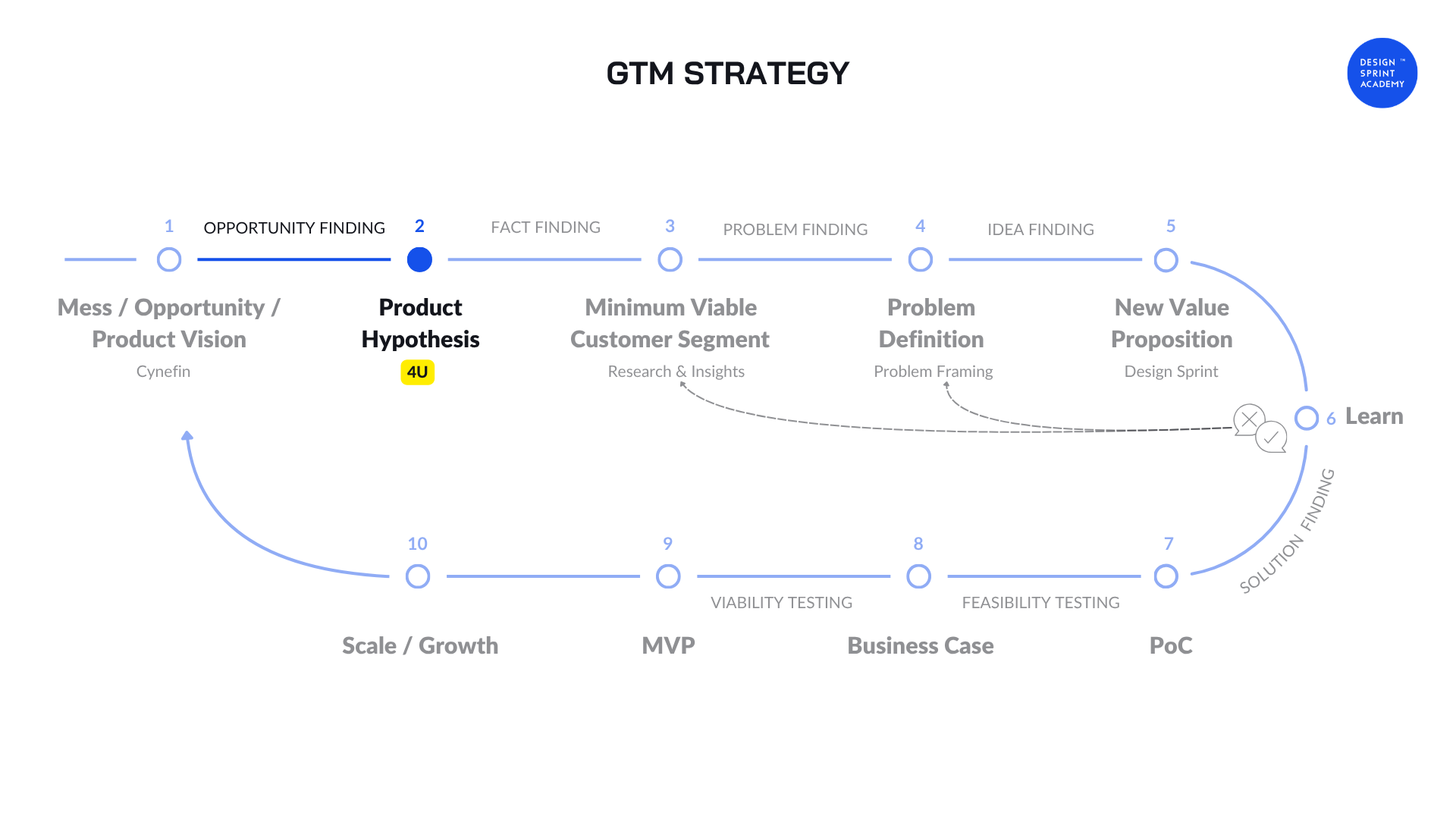
It also works well as a standalone two-hour prioritization session when a leadership team needs to align quickly on what comes next.
Why aligning senior stakeholders on the right problem is the highest-leverage decision an organization makes
The costliest mistakes inside large organizations are not failed projects. They are well-run projects that should never have started. They get funded because one senior leader pushes hard, not because the leadership team agrees they deserve priority.
You see the same pattern again and again.
A group of senior leaders enters the room, each carrying a different agenda, KPI, and functional pressure. Marketing wants the brand initiative. Operations wants the efficiency program. Product wants the new platform. Sales wants verticalization.
Each leader is right from where they sit. None of them is wrong. But the organization does not have enough money, time, or attention to fund every priority well.
And no one wants to be the function that steps back.
So the team follows the political path of least resistance. They say yes to everything. They fund it all at half scale. They hope the priorities will sort themselves out later. They never do.
The organization ends up running fifteen low-conviction efforts instead of committing to the two or three problems that would move the business. By year-end, every individual program looks fine on paper, but the business has barely moved. The senior team feels frustrated because activity was high, but progress was thin.
The 4U Framework gives leaders a way out of that stalemate.
It does not pretend politics disappear from the room. Senior leaders still bring their influence, incentives, and beliefs with them.
But it changes the conversation.
Instead of asking, “Whose initiative wins?” the group asks, “Which problem scores highest against the criteria we agreed matter?” That shift matters. The criteria are visible. The scoring is shared. The trade-offs are easier to name.
And the priorities that emerge are owned by the group, not by one dominant function. That is what makes the decision stronger once everyone leaves the room.
A priority chosen through shared scoring has a better chance of surviving the next leadership meeting, budget challenge, or change in momentum. Consensus-by-PowerPoint rarely passes that test. Shared ownership does.
.png)
What does each dimension of the 4U Framework mean?
Each dimension asks a different question about the problem.
Leaders score each one from 1 to 5. The goal is not to create one perfect number. The goal is to build a profile of the problem.
A strong problem often scores high across several dimensions, but the pattern matters. Some problems are painful but not urgent. Some are urgent but already well served. Some are unavoidable but still manageable.
The 4U Framework helps the group see those differences clearly.
Unworkable asks: How broken is the current situation?
A high score means the current way of working is creating real pain. Teams are wasting time, customers are frustrated, costs are rising, or the business is being held back.
A low score means the problem exists, but people have found ways to live with it.
Unavoidable asks: How hard is this problem to ignore?
A high score means the organization has to deal with it. Market shifts, customer expectations, regulation, competitive pressure, or internal complexity are forcing the issue.
A low score means the problem is optional. It would be nice to solve, but the business is not under real pressure to act.
Urgent asks: How soon does this need attention?
A high score means delay creates risk. The longer the organization waits, the more expensive, disruptive, or difficult the problem becomes.
A low score means the problem matters, but timing is not critical yet.
Underserved asks: How poorly is this problem being addressed today?
A high score means current solutions are weak, fragmented, expensive, or missing altogether. The organization has a clear gap to close.
A low score means the problem already has decent solutions, either inside the business or in the market.
Together, the four dimensions help senior leaders move beyond personal preference.
Instead of asking, “Which initiative do we like most?” the group asks, “Which problem is most broken, hardest to avoid, most time-sensitive, and least well served?”
That is where prioritization becomes clearer.
Not easier. Clearer.
How do you score problems using the 4U Framework?
The scoring works in four steps: gather the candidates, bring the right leaders into the room, score each problem on each dimension, then read the resulting profile rather than just the total.
The goal is not to turn strategy into math. The goal is to give senior leaders a shared way to compare problems that are usually argued from different angles.
Step 1: Surface the candidate problems from both sides
The best candidate list comes from two sources.
The first source is the person or team running the session. Often, this is a PM, product lead, innovation lead, or strategy owner. They bring the work already done: customer signals, market shifts, research findings, opportunity backlogs, and problems the organization has already noticed.
This gives the room a structured starting point.
The second source is the senior stakeholders themselves.
Before the session, speak with each leader individually. You are looking for the problems they believe the organization needs to tackle next, especially the ones that have not gained shared commitment.
Three questions do most of the work:
- What problems do you most want the organization to tackle next?
- Where is buy-in stuck?
- Which problems feel like bigger bets, higher-risk, harder to justify, or easier to postpone?
These questions surface the problems with real weight behind them.
Some will be functional priorities. Some will be customer or market issues. Some will be strategic bets everyone senses matter, but no one has managed to get the full leadership team behind.
Between the prepared candidates and the stakeholder interviews, you usually end up with around ten serious problems worth scoring.
That is enough to create choice without overwhelming the room.
Step 2: Bring the right group into the room
This is a senior-leader session.
The room should include the leaders who own the agendas competing for the organization’s focus. That often means product, technology, marketing, sales, operations, customer, finance, or strategy.
Six to eight people is the right size. Fewer than six, and the room is too narrow. More than ten, and it is hard to manage the discussions.
The cross-functional mix matters because each function sees the same problem differently. A problem might look unworkable to marketing and minor to engineering. It might feel urgent to sales and slow-moving to product. That disagreement is not a problem with the workshop. It is the reason to run it.
A single-function room will produce a confident single-function answer. The rest of the organization will likely ignore it.
Step 3: Score each problem individually first
For every candidate problem, each participant scores all four dimensions from 1 to 5:
- Unworkable
- Unavoidable
- Urgent
- Underserved
The scoring should happen individually before group discussion.
This part matters. If the group debates first, the loudest person in the room shapes the scores before anyone has committed to their own view. Sometimes that is the most senior leader. Sometimes it is the person with the strongest opinion. Either way, the room starts converging too early.
Individual scoring protects the signal.
A practical setup is simple. Put each problem on a card, slide, or Miro frame. Each participant adds four scores. Then the group reviews the aggregate.
The most useful discussion usually comes from the widest score spreads. That is where the disagreement lives.
If sales scores urgency as a 5 and product scores it as a 2, the group needs to understand why. The gap often reveals different assumptions about customers, timing, technical effort, competitive pressure, or business risk.
That is where the real alignment work happens.
Step 4: Read the profile, not just the total
The easiest mistake is to add the four numbers and pick the highest total. The total helps, but it does not tell the whole story.
The shape of the score matters more. A problem scoring 5/5/5/2 is different from a problem scoring 4/4/4/4.
The first problem has strong pain, pressure, and urgency, but the low underserved score raises a question. Maybe the market already has strong solutions. Maybe the organization already has a decent answer. Maybe solving it will be hard to differentiate.
The second problem has no single dramatic spike, but it is strong across the board. It has pain, pressure, timing, and a meaningful gap. That often makes it a stronger bet.
A useful rule of thumb: Prioritize problems that score 4 or higher on at least three dimensions, with no dimension scoring 1 or 2.
A low score does not automatically kill a problem, but it needs discussion.
A 1 or 2 is a warning sign. Maybe the problem is not urgent enough. Maybe it is already well served. Maybe the current situation is annoying, but not broken. Maybe it matters to one function, but not to the business as a whole.
The point is not to let the numbers decide for the group. The point is to force a better conversation before the organization commits serious time, money, and attention.
A worked example: why Juicero failed against the 4U Framework
Juicero launched in 2016 with $120M in venture funding, a $400 juicer, and proprietary single-use produce packs.
Sixteen months later, it shut down.
At the time, it became one of the most visible consumer product failures of the decade. The 4U Framework helps explain why. Not because the problem was fake. The problem was real in parts. The issue was that Juicero was the wrong solution in a market that already had plenty of better, cheaper answers.

Unworkable: 3/5
Juicero was trying to solve a real annoyance.
Fresh juicing at home is messy. You need to buy produce, cut it, juice it, clean the machine, and deal with the pulp. For busy professionals, especially people rushing in the morning, that hassle matters. So the problem deserves some credit.
A 3 feels right. The current situation was inconvenient, but not broken.
Nobody’s day collapses because they don’t own a connected juicer. People already had plenty of ways around the issue. They bought bottled juice. They used normal juicers. They grabbed a smoothie on the way to work. Or they skipped juice entirely.
Annoying is not the same as unworkable. That distinction matters.
Unavoidable: 4/5
The broader problem Juicero pointed toward was much more serious.
Poor diet, skipped meals, convenience food, low fruit and vegetable intake, and declining wellbeing are not minor issues. They build slowly and show up later as chronic illness, lower energy, lost productivity, and higher healthcare costs.
That problem is hard to ignore.
People do need better ways to eat well, especially when work and life make healthy routines difficult. So the underlying problem scores high here.
A 4 makes sense.
But this score is about the problem, not Juicero’s answer to it.
That difference is where many companies fool themselves. They find a real problem, then assume their product deserves the same level of importance.
It doesn’t.
Urgent: 3/5
For Juicero’s target customer, the pressure was daily.
Busy urban professionals often need something fast in the morning. They have limited time, long workdays, and plenty of bad food options around them. The desire for quick, healthy nutrition is real.
So again, this is not a zero. The problem shows up every day. But the urgency does not point directly to Juicero.
A rushed morning does not create an urgent need for a $400 appliance. It creates a need for something fast, healthy, affordable, and easy.
That opens the door to many alternatives: a smoothie, a protein shake, a bottled juice, a yogurt, a banana, a prepared salad, or a cheaper home juicer.
The timing pressure was real. The product-specific urgency was weak.
That is why this lands at 3, not 5.
Underserved: 1/5
This is where Juicero falls apart.
By 2016, fast and healthy convenience was already a crowded category. The target customer had options everywhere.
Not theoretical options. Real ones.
- Smoothie and juice chains offered fresh drinks for roughly $5–10.
- Bottled cold-pressed juices were sitting in supermarket fridges.
- Grab-and-go salads and meal kits solved the broader meal problem.
- Meal-replacement shakes targeted the same busy-professional use case.
- Cheaper home juicers cost far less and used normal produce.
- Whole foods like bananas, nuts, and yogurt solved the same nutrition gap with no machine at all.
For Juicero to score well on Underserved, those alternatives needed to miss something customers deeply cared about.
They didn’t.
Juicero was more expensive than the alternatives. It was less flexible because it depended on proprietary packs. And it offered no clear functional advantage strong enough to justify the price.
The viral hand-squeezing video made the weakness impossible to ignore. If customers could squeeze the packs themselves and get the same juice, the $400 machine no longer looked essential. It looked decorative.
That is the fatal finding.
The market was not underserved. It was over-served.
Juicero entered a category with many substitutes across many price points, then tried to win with a connected appliance customers had not been asking for.
A connected juicer was the differentiator.
The market treated that differentiator as worthless.
Total: 11/20
Juicero’s 4U profile looks like this:
- Unworkable: 3
- Unavoidable: 4
- Urgent: 3
- Underserved: 1
The pattern tells the story.
There were three real-problem signals. The inconvenience was real. The health issue was real. The daily time pressure was real.
But the Underserved score kills the opportunity.
The 4U rule of thumb is to prioritize problems that score 4 or higher on at least three dimensions, with no dimension at 1 or 2.
Juicero fails both tests.
That diagnosis is more useful than saying, “It was a bad idea.”
The sharper diagnosis is this: Real problem, wrong solution.
Juicero pointed at a genuine need, but the market already had cheaper, easier, more flexible ways to meet it. A 4U scoring session would have surfaced that weakness early, before the company confused a real health and convenience problem with a strong product opportunity.
That is one of the main failure modes the framework catches.
And it is especially hard to see from inside a company that has already raised $120M around the idea.
Where does 4U fit before Problem Framing and Design Sprints?
The 4U Framework sits before Problem Framing and Design Sprints.
Its role is simple: decide which problem deserves deeper work.
4U is an Opportunity Finding tool. You run it with senior leaders before the one-day Problem Framing workshop, at the point when the organization still has several competing problems on the table.
The leadership team scores those problems against the four 4U dimensions:
- Unworkable
- Unavoidable
- Urgent
- Underserved
The output is a shortlist of one to three problems worth investigating further.
From there, the sequence is clear.
1. Opportunity Finding: choose the right problem
This is where 4U fits.
Senior leaders bring the candidate problems into the room. They score each one, compare the profiles, and align on which problems deserve attention.
The goal is not to solve anything yet. The goal is to stop the wrong problem from entering the next stage.
By the end of the session, the group has a shortlist. Often, one problem rises to the top. Sometimes there are two or three worth deeper investigation.
2. Problem Framing: define the problem properly
The top problem from the 4U session becomes the input for the one-day Problem Framing workshop. This is where the team goes deeper.
They use customer research, market data, stakeholder knowledge, and business context to understand what is really happening. They separate symptoms from causes. They clarify who has the problem, why it matters, and what would need to change.
The output is a validated problem statement. A problem clear enough to guide solution work.
3. Design Sprint: test a solution
Once the problem is framed, it feeds the Design Sprint.
The Design Sprint is where the team explores and tests how to solve the problem. It moves from problem clarity into solution validation with real users.
So the three stages answer three different questions:
- 4U asks, “Which problem is worth our attention?”
- Problem Framing asks, “How should we define this problem?”
- Design Sprints ask, “What solution should we test?”
That order matters.
❌ Without 4U, teams often take the wrong problem into Problem Framing.
❌ Without Problem Framing, teams take a vague or poorly understood problem into a Design Sprint.
❌ Without a Design Sprint, teams move from a framed problem into solution work without enough validation.
4U also works on its own.
A leadership team does not need a full Problem Framing engagement to use it. As a standalone two-hour session, 4U gives senior leaders a fast way to compare competing priorities and align on what comes next. It does something valuable. It forces the leadership team to stop asking, “Whose idea should we back?”, and start asking, “Which problem deserves the next serious investment of time, money, and attention?”
More resources on this topic
If this guide was useful, three more pieces worth bookmarking:
- The Workshop That Could Have Saved Quibi $1.75B — what a misjudged-problem failure looks like, scored through the four lenses. A cautionary-tale read for facilitators. Read the article
- How Product Managers Help Decision-Makers Prioritize Problems Using the 4U Framework — the PM-specific playbook for proposing, preparing, and running a 4U session with senior stakeholders. Read the article
- The 4U Framework Live with 100 Facilitators on Miro — the recap of our webinar walking through the workshop in front of a hundred-facilitator audience. The session flow, the moves that worked, and what we'd change next time. Watch the recap