8 Proven ways to apply Problem Framing and Design Sprints in business

Why Problem Framing and Design Sprints have grown beyond product development
Design Sprints were originally built at Google Ventures to help startups de-risk product decisions. Five days, a defined challenge, a working prototype, real user feedback. The 2016 book Sprint by Jake Knapp made the method a global phenomenon.
What happened next was less expected. Large organizations adopted the method, then quickly discovered that the original five-day format was hard to apply to their reality. Their problems were less defined. Their stakeholders were more numerous. Their politics were heavier. The challenge was rarely which solution should we build; it was which problem are we even solving, and do we agree on it?
Problem Framing emerged to fill that gap. A one-day strategic workshop run before any sprint, designed to get senior decision-makers aligned on a real problem grounded in real data. With Problem Framing in front of Design Sprints, the methods started working in environments far beyond their original product-development context.
This article covers eight scenarios where the combination of Problem Framing and Design Sprints has produced real outcomes inside organizations — with examples from teams that have used them well.
Scenario 1: De-risking product development
The most common application, and still one of the highest-impact.
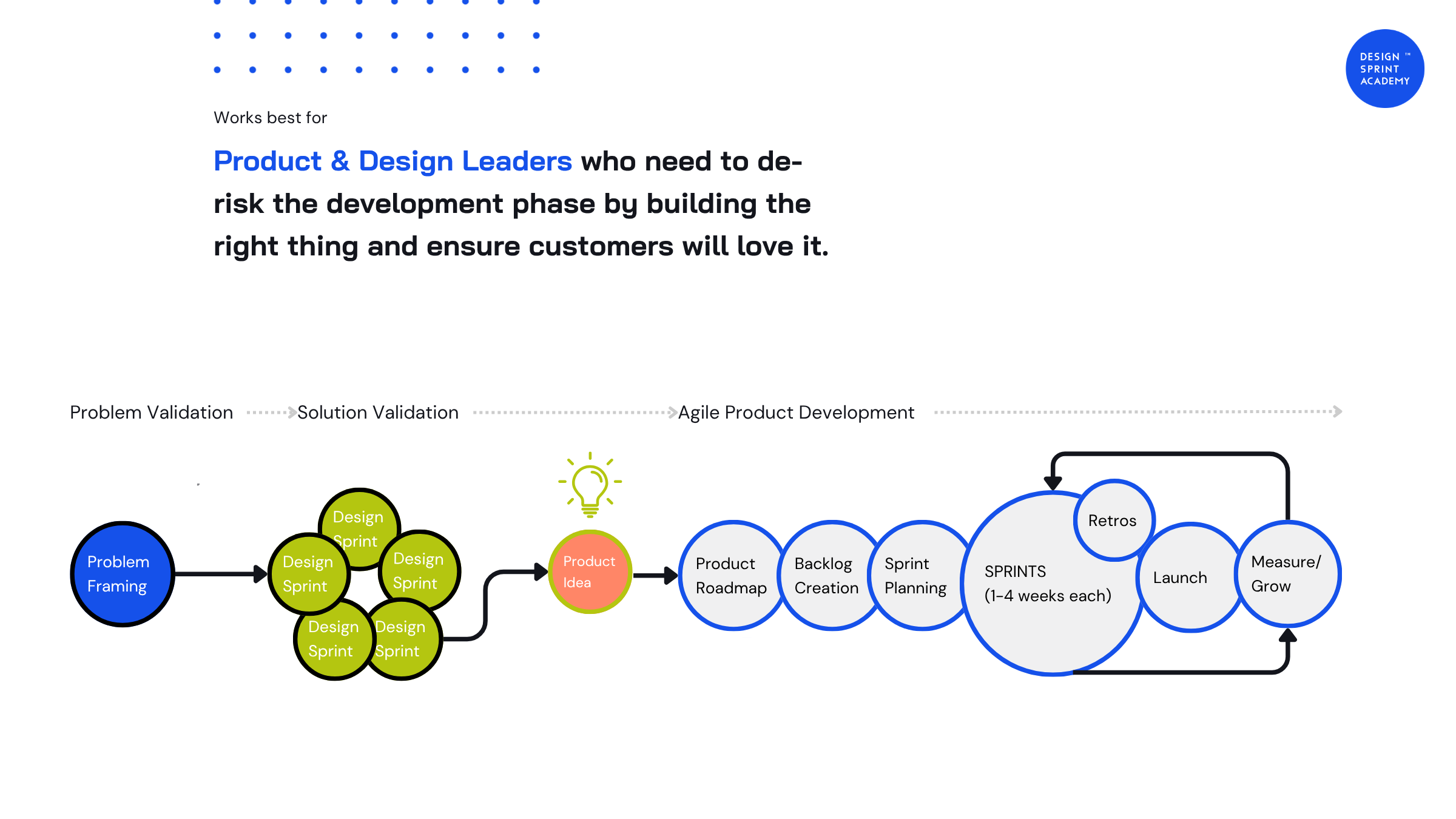
The pattern: A product team takes a stream of ideas — from customers, business directives, internal hypotheses — and turns them into roadmap items, then user stories, then sprints, then features. The full development engine spins up: product managers, designers, engineers, QA, sometimes business analysts and marketing. If the original idea was wrong, every step amplifies the cost.
How Problem Framing and Design Sprints fit:
- Problem Framing validates which problems are worth solving in the first place. Strategic decisions made with senior stakeholders, grounded in customer data, before anything reaches the roadmap.
- Design Sprints validate solutions before they reach the development cycle. Four days to a tested prototype with real user feedback.
The honest version: Garbage in, garbage out. Even an extremely efficient agile delivery cycle will produce nothing useful if it's fed bad ideas. Most organizations spend enormous effort optimizing the delivery cycle and almost none validating what enters it. Problem Framing fixes the front of the funnel; Design Sprints fix the middle.
Best for: product, innovation, and digital teams under quarterly delivery pressure who keep shipping features no one uses.
Scenario 2: Streamlining the innovation funnel
The pattern: Most large organizations have more ideas than they can possibly fund. Innovation pipelines fill with submissions from internal teams, hackathons, customer feedback, leadership hunches, and consultancy reports. The challenge isn't generating ideas. It's filtering.
How Problem Framing and Design Sprints fit:
- Problem Framing filters the pipeline against business strategy. Which of these many ideas align with where the organization is actually going? Which solve real customer problems? The workshop produces a short list of validated opportunities backed by leadership.
- Design Sprints rapidly validate the short list with real users. Each sprint produces a tested prototype, which can be turned into a business model and built through a venture-builder program or product team.
Best for: innovation managers, transformation leads, and corporate venture teams managing a large flow of ideas without a structured way to choose between them.
.png)
Scenario 3: Innovation hackathons that actually produce value
The pattern: Most corporate hackathons are theater. Energy is high, demos are polished, prizes are awarded, and three weeks later nothing has shipped. The teams worked on whatever they wanted, the problems weren't connected to the business, and the prototypes don't survive contact with reality.
We call these innovation theater. Most companies running them know they're producing limited value but don't know how to fix it.
The fix: Front the hackathon with Problem Framing.
- A small group of business sponsors and senior stakeholders runs a Problem Framing session ahead of the hackathon. Three to five challenges emerge — each one tied to a real business priority, grounded in customer or operational data.
- The hackathon is then opened to the whole organization. Employees self-select into the challenges they care about and have expertise on.
- Each team runs a compressed two-day Design Sprint format. Cross-functional teams (not just engineers — the "hackers" in the original term). Real customers brought in to test the prototypes.
- The best prototypes are handed to product or innovation teams to scale.
A real example: A manufacturing company ran this format with us. Innovation, design thinking, and agile concepts were entirely new to their workforce. One team produced a prototype that, on paper, looked deeply unglamorous — a small process improvement on a factory production line. The change saved the company $20 million per year in operational cost.
Best for: innovation managers and transformation leads running hackathons that need to produce something the business will actually adopt. Available as case studies on the DSA blog: SAP (multi-year remote hackathon engagement during the pandemic) and Turner Construction (Innovation Days format).
.png)
Scenario 4: Sustainable innovation with a quarterly cadence
The pattern: Innovation that depends on heroic individuals or one-off events doesn't compound. Six months after the hackathon, the energy has dissipated. The next reorganization absorbs the team. The capability never becomes part of how the organization works.
The fix: an Innovation Accelerator running on a quarterly cadence. Explore → Experiment → Exploit.
- Explore (Problem Framing). At the start of each quarter, key decision-makers run a Problem Framing session to identify the top priorities for the next ninety days. Customer-grounded, business-aligned, time-bound.
- Experiment (Design Sprints). During the quarter, the innovation team runs Design Sprints on the prioritized opportunities. One sprint per priority, validating with real users.
- Exploit. Validated prototypes are handed to production teams to scale. Failed experiments are killed cleanly with the learning captured.
The key point is the rhythm. Once a quarter, on a predictable schedule, the organization runs the same pattern. The capability becomes part of how the team works rather than something special that requires permission and budget every time.
Best for: innovation strategy owners and transformation leads who need to make innovation a repeatable system, not a series of events.
.png)
Scenario 5: Launching new ventures and intrapreneurial products
The pattern: Corporate venture-building, internal startups, and new product launches all face the same fundamental risk — product-market fit. Without it, the venture fails regardless of how well it's funded. With it, almost everything else can be solved.
How Problem Framing and Design Sprints fit:
- Problem Framing helps the team find the right opportunity to bet on. Which customer audience? Which problem? Why this one over the others? The workshop produces a clear, validated direction.
- Design Sprints — typically several in sequence, not just one — take that direction and validate solutions until product-market fit emerges. One sprint to test the core concept. A second to refine the value proposition. A third on a specific feature or workflow that became contentious. The pattern continues until the team has validated evidence of demand.
Once the validated concept exists, it transitions to a business model and a build phase.
Best for: intrapreneurs, internal venture teams, and corporate innovation leads launching new products or business lines from inside an established company.
Scenario 6: Kicking off external partnerships and joint ventures
The pattern: Two large organizations decide to partner. The partnership process is then absorbed by the slower-moving of the two organizations — typically meaning eighteen months of legal and procurement before any actual co-creation begins. By the time the joint venture launches, market conditions have shifted and the original opportunity is half gone.
How Problem Framing and Design Sprints fit:
- Problem Framing brings stakeholders from both organizations into a single workshop to align on the mutually interesting problem. Each side comes with their own context and priorities. The workshop produces a shared problem statement and a clear sense of where each party adds value.
- Design Sprints then run with cross-organizational teams. Designers, engineers, and product people from both companies in the same room, prototyping together. The result is a tested concept both organizations have already co-created — which is dramatically easier to push through legal and procurement than an abstract joint venture proposal.
Best for: partnership leads, business development directors, and strategy teams running joint ventures that need to move faster than their bureaucracies typically allow.
Scenario 7: Optimizing internal processes and digital transformation
The pattern: Process optimization and digital transformation programs often start with a solution in search of a problem — we need to digitize the customer onboarding flow, we need to automate the procurement process, we need a new CRM. The solution is articulated before anyone has rigorously validated which step in the process is actually broken.
How Problem Framing and Design Sprints fit:
- Problem Framing maps the existing process and identifies the real bottlenecks. Which step is slow? Which step breaks down? Where are people doing manual workarounds? The workshop produces a clear picture of where intervention will have the largest impact.
- Design Sprints then prototype the targeted intervention. Not a full process redesign — a focused fix at the point of highest leverage, validated with the people who will actually use it.
This sequence dramatically increases the success rate of digital transformation work, which historically has a poor track record because the technology gets chosen before the problem is clearly defined.
Best for: operations leaders, process improvement teams, and digital transformation directors who need to know what to actually change before committing to the change.
.png)
Scenario 8: Boosting team collaboration with sprint elements
The pattern: Sometimes the team doesn't need a full four-day Design Sprint. They need a way to align faster, ideate better, or make a stuck decision. A two-hour workshop using elements from the Design Sprint method can do the job.
How sprint elements work as standalone workshops:
- Empathy mapping (2 hours): quickly align the team on who the customer is and what they need.
- Goal setting (2 hours): when the team is unclear on what success looks like for the next quarter or project.
- Ideation (1–2 hours): when the team is stuck and needs to generate options structurally rather than through unstructured discussion.
- Prototyping and feedback (2–3 hours): rapid validation of a specific feature or concept without committing to a full sprint.
These aren't replacements for a full Design Sprint when one is needed. They're tools the team can pull off the shelf when the challenge is smaller and the bar is lower.
Best for: team leads, facilitators, and product or innovation managers who want sprint-quality collaboration in a smaller container.
.png)
How to choose the right scenario for your situation
A short matching exercise:
- Shipping features no one uses? Scenario 1.
- Drowning in ideas, can't pick which to fund? Scenario 2.
- Hackathons that produce nothing the business adopts? Scenario 3.
- Innovation depends on heroes and one-off events? Scenario 4.
- Launching a new product or internal startup? Scenario 5.
- A joint venture that's been stuck in legal for a year? Scenario 6.
- Digital transformation budget about to be committed to a tool? Scenario 7.
- The team needs to align faster on something specific? Scenario 8.
Most organizations have at least three of these patterns happening simultaneously. Picking the highest-leverage one to start with is the move — not trying to apply the methods everywhere at once.
Where to start
Look at the eight scenarios. Find the one that most closely matches what's currently broken or stuck in your organization. The match doesn't need to be exact — these patterns overlap and most organizations have multiple at once.
The lowest-risk first move is almost always Problem Framing. Half a day to two hours of leadership time. Customer data on the walls. A clear, validated problem statement at the end. From there, the path to a Design Sprint and beyond becomes straightforward, because leadership has already committed to the problem the sprint will solve.
What these methods provide is not magic. It's structure. They take work that organizations already do badly — deciding what to build, choosing where to invest, aligning across teams — and they make that work happen in a focused, time-boxed format with clear outputs. The method is the constraint. The constraint is the value.
Watch the full webinar
.png)