
What is an AI Facilitator? Role, skills & toolkit

Every organization today wants AI to deliver real impact.
Yet few have achieved it.
Despite widespread usage, most companies remain in the earliest stages of scaling AI and turning their AI efforts into enterprise-level value. This is the AI paradox: around 80% of organizations use AI, but only 1% see meaningful results.
Why does AI feel harder than it should?
Most organizations don’t realize how much the answer to this question depends on them — not on the technology, the tools, or the skillset.
The technology has proved itself. It advances at an unprecedented pace. It is already the worst it will ever be — and it will only get better from here.
Tools are everywhere. Most companies have already purchased organization-wide licenses for the major platforms. It is difficult to find someone who isn’t using AI in some form.
And substantial investment is going into training: AI fluency programs, prompting and tool usage, automation and workflow courses, AI skill-building across functions.
All in all, a lot of effort goes into these areas. They are the most obvious, straightforward investments an organization can make. And while they are necessary — and often useful — they rarely translate into large-scale impact.
These investments are foundational, but they are not transformational.
Because the real blockers of AI adoption sit somewhere else.
Not in the tools.
Not in the skills.
Not in the technology.
They sit in the way organizations think, decide and work together when AI is involved. And this is where the real problems begin to surface.
Leadership mandates are still vague — often along the lines of “do something with AI.” The middle gets told to make it happen with tools they barely understand and systems that barely hold together. This creates pressure without direction. Teams get confused and either stumble or freeze because they can move only as confidently as their leaders show up.
AI is uncharted territory. Everyone is still figuring it out. Most things won’t work. Some will. But most organizations lack a system for fast, evidence-based learning. The traditional incentive is to build and ship (which AI only accelerates). With AI, the incentive should be killing as many bad ideas as possible.
AI touches every function — business, tech, data, legal, operations. But these groups typically operate in silos, rarely talk to each other, and when they do, they speak different languages and have different views of AI — along with their own priorities and goals.
People jump into solutions before understanding the problem and without clearly articulating how AI will create value. Vague use cases generate vague results. Most pilots fail because they never shift how the business actually works.
Related to this, any broken process or customer experience will only get worse. AI magnifies existing flaws. Teams should rethink processes and experiences first — but this work feels “non-AI” and unappealing, so it gets skipped. Which means they build on shaky foundations.
At the end of the day, everything about AI is the result of decisions made by people and how they work together. And the truth is that most organizations have not figured this out in decades. AI decisions are not easy, and the more complex the project, the more people involved, the slower everything becomes. The traditional model for collaboration and decision-making — meetings after meetings — is too slow and cannot keep up with the pace of AI.
The AI Facilitator — A New Role for a New Kind of Work
An AI Facilitator is a specialist who helps organizations make confident, structured decisions about AI — guiding cross-functional teams from vague mandates to validated use cases and tested solutions.
As AI accelerates, companies don’t just need more AI tools, more training, or more technical talent. They need a different way of working — one built for clarity, speed, and cross-functional decision-making.
This is where the AI Facilitator comes in.
An AI Facilitator is not another technical role, strategy role, or product role. It is a new function designed specifically for the ambiguity and cross-disciplinary complexity of AI work.
At its core, an AI Facilitator helps teams make confident decisions about AI — not by providing answers, but by guiding the structured thinking needed to find them.
An AI Facilitator is uniquely suited to the challenges of AI work:
- Turns AI ambition into actionable focus. Helps leadership teams shift unclear mandates into clearly defined opportunity areas in the business where AI can create measurable value.
- Maps the broken processes, workflows and customer experiences. The unglamorous work no one wants to do, but the foundation of most real-world AI wins.
- Brings together the relevant experts — business, engineering, data, design, operations, legal — to identify, define and prioritize high-value AI use-cases
- Works with teams to co-create AI-solutions, evaluating feasibility, risks and constraints, and validating desirability with users / customers.
- Designs and implements fast, evidence-based learning cycles, where ideas are tested, stress-tested, and — when needed — killed early, before they turn into useless AI
- Operates across all levels of the organization. From aligning leadership, to structuring mid-level discovery, to guiding practitioners in prototyping and testing, or leading AI Hackathons — ensuring each step connects and compounds.
However, the most important distinction is this:
The AI Facilitator does not make decisions or build solutions. The team does.
The AI Facilitator owns the process that allows the team to think clearly, decide together, and build on solid foundations. But that does not mean they are detached from the outcome.
They are far more than a guide applying a process.
Their responsibility is to ensure the conditions for success are present — the right people in the room, the right information surfaced early, the right data, constraints, and realities understood. And, critically, they must be willing to say no when those conditions are not there.
Because without the right conditions and ingredients, even the best process will fail.
So while the AI Facilitator is neutral in decision-making, they are not neutral in responsibility. They are not a passive spectator — they are accountable for the environment in which teams make decisions and create outcomes.
How the AI Facilitator Is Different From Other AI Roles
When a new role emerges, people instinctively map it to something they already know — AI Strategist, AI Product Manager, AI Engineer, Consultant, Trainer, or even a generic facilitator.
But the AI Facilitator doesn’t fit into any of these categories (though there are some overlaps)
It’s a distinct role built for the specific challenges of AI adoption: high ambiguity, cross-functional dependency, and decisions that require business, technical, and operational alignment.
Here’s how it differs from the roles people often confuse it with:
❌ Not an AI Strategist
Strategists set direction. They define AI ambition, priorities, and roadmaps.
The AI Facilitator does not set strategy — they translate it into clarity and structured decision-making so teams can act on it without confusion or misalignment.
❌ Not an AI Product Manager
Product Managers own the problem and the solution.
The AI Facilitator owns neither. Their role is to ensure problems are well-framed, assumptions surfaced, risks understood, and decisions grounded in evidence — before execution begins.
❌ Not an AI Engineer or Data Scientist
Engineering and data teams build the solution. They are responsible for feasibility, architecture, integration, and delivery.
The AI Facilitator doesn’t build. They create the environment where these technical voices are heard early, and where constraints become inputs — not late blockers.
❌ Not an AI Consultant
Consultants bring expertise and answers.
The AI Facilitator doesn’t arrive with answers. They guide teams through the structured thinking needed to generate and validate answers that fit their reality.
❌ Not an AI Trainer
Trainers build AI skills and fluency.
The AI Facilitator takes those skills and applies them to real work — moving teams from knowing about AI to making decisions and building validated concepts with it.
❌ Not a Generic Workshop Facilitator
General facilitation supports alignment, collaboration, and communication. A regular facilitator will come in and run a workshop here and there on specific challenges.
The AI Facilitator is different. They are deeply immersed in the entire AI journey and operate at all levels of the organization — from leadership to boots-on-the-ground teams. They don’t run isolated workshops; they connect the dots and piece together the full picture.
Their toolkit is also specialized and adapted to the nuance and specificity of AI work — as you will see further in this article.
And then there’s accountability. Traditional facilitators see themselves as the guide, not the hero. Their focus is often on delivering a great workshop.
The AI Facilitator is as accountable for the AI initiative as the teams and leaders they work with. They remain neutral in decisions, but fully accountable for the conditions that lead to the right outcome.
The AI Facilitator Toolkit
So let’s see how this works in practice.
AI work is messy by default. The AI Facilitator brings a structured way to think, decide, and collaborate, helping organizations achieve three main outcomes:
→ What do we want AI to do for our business?
→ What should we solve with AI? What are the valuable use-cases?
→ How should work change because of AI?
→ What should we build with AI?
Answering any of these questions requires input and buy-in from multiple stakeholders across functions. Getting to alignment and a clear decision is both complex and time-consuming. Typically it involves countless meetings, emails, and back-and-forth. Business as usual — but what was tolerable in the past is no longer sustainable, because it cannot keep pace with AI.
To make progress, organizations need a faster way to move from ambition → clarity → validated outcomes.
This is exactly what the AI Facilitation Framework is designed to do. It provides a repeatable operating system — a set of “AI” workshops that bring the right people together at the right moment and accelerate decision-making.
It starts with leadership alignment through the AI Strategy Workshop. → Then AI Problem Framing turns strategic priorities into concrete AI opportunities. → From there, the path depends on the challenge. → Internal workflows need redesigning through an AI Workflow Sprint. ↔ Customer-facing products and services need prototyping and validation through an AI Design Sprint.
While every organization is different the AI Facilitation Framework works in most cases because it addresses universal challenges: What’s our strategy? What problems should we solve? What should the solution look like?
Let’s see how the AI Facilitation Framework addresses each of these.
1. AI Strategy Workshop - Where should we focus?
This is where leadership alignment happens.
Most organizations jump into random experiments and pilots, before agreeing on what AI should actually do for the business. Without this foundation, everything that follows becomes guesswork.
In this first stage, the AI Facilitator helps leadership:
- Align on the role of AI in the business.
- Identify where AI can meaningfully reduce costs, increase revenues, optimize workflows, or improve customer experience.
- Define a set of priority, strategic opportunity areas worth exploring.
- Establish boundaries, risks and success criteria
The outcome of this workshop is direction. A high-level roadmap for AI adoption and first steps.
Teams no longer guess what matters or chase random ideas. They know where to focus.
Once that’s clear, we move to the next stage — where AI ambition must be translated into concrete opportunities. This is where AI adoption fails in most organizations: teams sit trapped between ambition and execution.
Not anymore. Stage one has created clarity.
Now the goal is to translate that clarity into high-quality, well-defined AI use cases.
Duration: A focused 3–4 hour session, or one full day for larger, more complex organizations.
Participants: Executive sponsors, strategy leads, key business leaders
Outcome: A clear AI direction, a prioritized list of strategic opportunity areas, and alignment across leadership on where to focus first
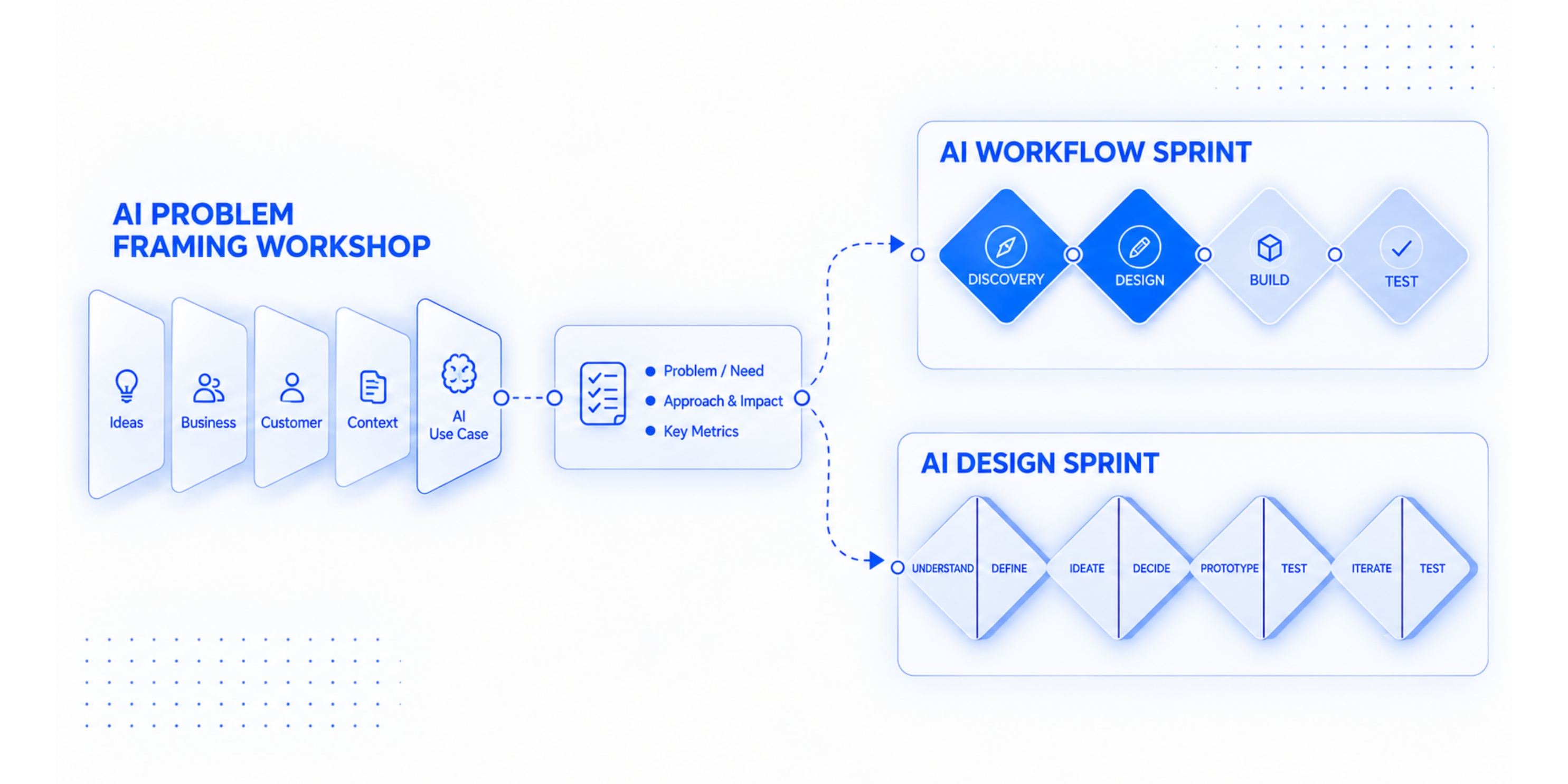
2. AI Problem Framing Workshop - What is worth solving?
This is where a cross-functional team comes together to define the real problem behind each opportunity area. This includes: domain experts and relevant decision-makers (stakeholders) and AI/tech experts.
In this stage, the AI Facilitator helps teams:
- Map the end-to-end internal process or customer journeys.
- Identify friction, inefficiencies, and unmet needs.
- Understand dependencies — data, systems, people, risks, compliance.
- Turn all of these insights into well-defined, high-quality AI use cases
- Prioritize AI use-cases based on impact, feasibility, and strategic fit.
A strong AI use-case clearly articulates who has the problem, what the problem is, how AI could help, and what value it could create — for both the business and the customer.
The main benefit is alignment: business leaders, domain experts, and technical teams — whether internal IT or external vendors — agree on what they are solving, why it matters, and how AI can help.
With well-defined use-cases in place, the next step is to create and validate an AI solution before any real investment. This not only tests the solution, but also tests the underlying assumptions about the problem itself. Some use-cases will turn out to be stronger than others — which is exactly why quick validation is essential to de-risk investment.
Duration: 1 full day (or two half-days) depending on complexity of the process and number of stakeholders involved.
Participants: Domain experts, relevant decision-makers, business stakeholders, engineering/IT leads, data/AI specialists, legal/compliance
Outcome: A set of well-defined, high-quality AI use cases with clear problem statements, value hypotheses, constraints, and feasibility considerations
3. AI Workflow Sprint - How should work change?
This is where many AI initiatives run into trouble.
A team identifies a promising use case. IT builds an automation or an AI assistant. Technically, it works.
But the work around it hasn’t changed.
People still follow the old process. The handoffs are still there. Decisions still sit with the same people. And the AI solution ends up as one more tool people are expected to use.
Because introducing AI into a workflow is not the same as redesigning the workflow.
An AI Workflow Sprint brings the people who share the work into the same room — business teams, domain experts, technical specialists and the people who will actually use the new way of working.
The AI Facilitator helps them:
- Understand the end-to-end workflow, including the handoffs and decisions between people and teams.
- Challenge which steps are still necessary, which could change, and where AI could genuinely help.
- Redesign the workflow around the combination of human judgement, AI capabilities and operational constraints.
- Make the future workflow concrete enough to examine, challenge and test before committing to implementation.
- Agree on what should change, what needs validating and what the technical team needs to take forward.
The main output is not an AI feature.
It is a redesigned way of working — with a clearer understanding of where AI belongs, where humans remain responsible, and what needs to be built or changed to make it work.
Duration: The sprint runs over multiple days, depending on the agreed format.
Participants: The people who own and perform the workflow, relevant decision-makers, and AI/IT specialists.
Outcome: A redesigned workflow, validated assumptions where testing is possible, and a clear direction for implementation.
4. AI Design Sprint - What should we build?
Not every AI opportunity is an internal workflow problem.
Sometimes the goal is to create a new AI-powered product, service or customer experience. Here, redesigning an internal process is not enough. The team also needs to know whether the proposed solution is useful to the people it is intended for.
And that is a different question.
An AI Design Sprint brings together product, design, business and technical expertise to shape a concept, make it tangible and test it with real users before significant resources are committed.
The AI Facilitator helps the team:
- Align on the customer problem and the assumptions behind the proposed solution.
- Explore different approaches without committing too early to one idea.
- Bring technical feasibility, data, risk and business constraints into the conversation from the start.
- Create a prototype that makes the proposed experience tangible.
- Test with users, learn what works and what doesn’t, and decide whether to move forward, iterate or stop.
The main output is evidence.
Evidence that people understand the concept. Evidence that it solves a meaningful problem. Or evidence that the team should rethink the idea before investing further.
That last outcome matters just as much as the first two.
Duration: The AI Design Sprint is structured around a four-day process.
Participants: A cross-functional product team, including business, product/design and technical experts, with users involved in testing.
Outcome: A tested concept and a clearer decision on whether to proceed, iterate or stop.
Why This Works — and Why Every Company Needs AI Facilitators Now
Organizations are beginning to understand that AI transformation is not simply about tools or technical capabilities. It is about connecting all the critical players — the leaders defining ambition, the domain experts who understand the real work, the product and engineering teams who need to build responsibly, the legal and compliance voices who keep things safe, and the frontline employees whose tacit knowledge determines whether any AI solution actually works in practice.
Every organization already has a clear, well-established process for delivery — Agile, Scrum, or some variation of it — and these processes work reasonably well once a solution is defined. But almost no organization has a structured way to navigate the early part of the journey, the part that matters most: what should we do with AI and why? What is worth solving? What is feasible? What will create real value for the business and the customer?
In other words, most companies have a way to deliver work, but not a way to decide what is worth delivering.
And this is exactly the gap the AI Facilitator fills.
Plug-and-play, not transformation
No one has the time or appetite to launch another transformation program, or to redesign how the organization operates. Most transformations never truly start, and those that do often produce another transformation. What companies need instead is something that slips into the existing way of working with minimal resistance — something that integrates with what they already do, but with dramatically better outcomes.
This is why the AI Facilitator and the AI Facilitation Framework fit so naturally.They don’t add a new layer of complexity. They simply replace unstructured meetings, alignment sessions, debates, and back-and-forth with structured, repeatable workshops. These workshops become familiar patterns — teams know what happens in each, what decisions are made, and how those decisions move their AI initiatives forward. They become a plug-and-play operating system for the early stage of the AI journey.
Immediate impact
The impact is immediate.
Decisions that normally take weeks or months are made in days. AI facilitation replaces slow, opinion-driven discussions with evidence, which in turn drives confidence. The entire organization gains a level of clarity and momentum that traditional processes cannot deliver.
Ideas are tested before resources are committed.Weak solutions are killed early, not after a six-month pilot.
This pace matters.AI moves fast, and organizations need a way to work at the same speed.
Enables blue ocean thinking
AI does not think. AI’s creativity is remixing existing patterns. There is no “blue ocean thinking.”
That is still something only humans can do. But AI can unlock possibilities like never before.
And to do that, organizations need a way to tap into their most valuable resource: their people — their brains, their expertise, and their creativity. The AI Facilitator becomes indispensable here, because they give structure to human–AI collaboration.
If AI expands the realm of what’s possible, then organizations need someone who knows how to unlock the human side of that possibility — someone who can take ambition, expertise, constraints, and creativity, and turn them into decisions and breakthrough solutions.
Closing
When you put all these pieces together, the role of the AI Facilitator becomes clear. It is the function that turns AI from scattered activity into a coordinated, strategic, and evidence-driven practice inside the organization.
They help leaders translate large AI ambitions into practical roadmaps.
They support product teams in validating ideas before anything is built.
They work with engineering and IT — internal teams or external vendors — to surface constraints early and ensure a smooth handoff from prototype to delivery.
They bring legal and compliance into the conversation before things go wrong.
And they help domain experts make their tacit knowledge explicit so AI can actually work with it.
This is not work that sits inside a single department.It is a dedicated function that connects all of them.
And that is why every company needs an AI Facilitator: to make AI real — by orchestrating the thinking, decisions, alignment, and learning that AI requires at every level of the organization.
.png)
.png)


