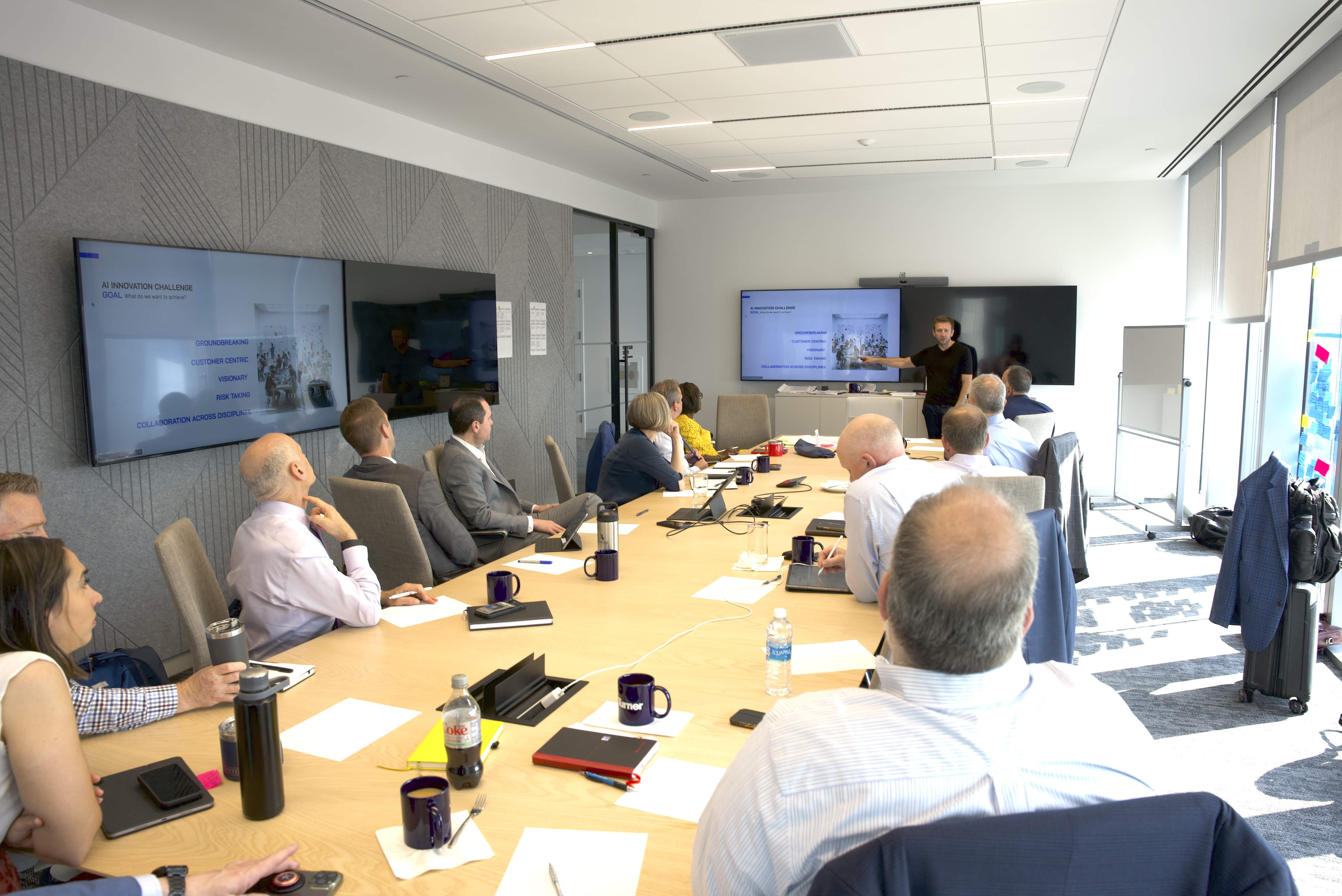
AI Labs work when they’re run like operating systems — not an IT or “innovation” side project. Led by a CAIO (or equivalent) and shared across tech, data, people, and business outcomes, they help teams make decisions faster, see constraints earlier, and drive adoption.
Most enterprises don’t have an AI adoption problem.
They have an AI fragmentation problem.
AI pops up everywhere—tools, pilots, roadmaps—but rarely where money is made: inside real workflows, at scale, with trust.
Teams move fast and still stall because use cases aren’t tied to business goals or end-to-end operations. Data, governance, and integration limits surface late, then land as a blocker.
Many initiatives also drift into internal productivity upgrades—faster emails, better summaries, smoother handoffs. Meanwhile the real upside comes from AI that changes the customer experience and the business model, not just the back office.
The result is the pilot-to-scale gap: lots of demos, thin adoption, and no repeatable way to decide what to build, what to scale, and what to stop.
AI Labs exist to fix this gap — not by building faster, but by deciding better.


AI Facilitators
Internal champions who turn business goals into decision-grade AI opportunities—and run high-stakes discovery sessions with rigor and focus.

AI Discovery Pods
Small, cross-functional teams formed around one business goal to explore, test, and make a call on AI opportunities—fast, focused, and owned.

2-Day AI Labs
Short, structured discovery loops that combine problem framing and design sprints to produce tested AI agents or workflows—and a clear build / scale / stop decision.
Step 1 - Training AI Facilitators
Build the internal capability first.
AI Labs start by training a small group of AI Facilitators. They’re not engineers. They’re business, product, or transformation leaders trained in AI Problem Framing, Design Sprints, and decision facilitation.
Their job is to run the 2-day Lab cadence with discipline—translating business goals into decision-ready AI opportunities and guiding teams to a clear build / scale / stop call.
Step 2 - Form AI Discovery Pods
Assemble the right team around a real business goal.
For each AI opportunity, an AI Facilitator forms a temporary Discovery Pod. Pods bring together business, tech, data, and risk early—before decisions harden. Each pod is accountable for one thing: turning ambiguity into a clear decision.
Step 3 - Run a 2-Day AI Lab
Design, test, and decide—fast.
Each pod runs a 2-day AI Lab
Day 1: Condensed AI Problem Framing to anchor the opportunity in workflows, users, data, and business value.
Day 2: Condensed Design Sprint to prototype and test AI agents or workflows with real users.
Step 4 - Decide and Act
Scale what works. Stop what doesn’t.
Validated opportunities move into delivery or scale with confidence.
Weak ideas stop early—before cost, politics, and complexity compound.
Learnings feed back into the Lab system.
Step 5 - Repeat as an Operating Cadence
From initiative to system.
AI Labs become a repeatable enterprise cadence—run by internal facilitators, aligned with leadership priorities, and embedded into governance.
.png)
The AI Lab Operating Kit is the complete system for leaders who want to build and run AI Labs in-house. It includes the structures, methods, and decision rhythm used by strong AI Labs: train AI Facilitators, form Discovery Pods, run 2-day Labs, and make clear build / scale / stop calls.
This is presale access with founder pricing. Full delivery is March 15, 2026, with permanent access to the system.