AI Champions and AI Facilitators: two jobs, not two levels

AI Champion programs were built for adoption. Many companies are now asking them to deliver transformation.
The AI Champion model is pretty straightforward: find the people who are curious about AI, give them early access to the tools, some extra training, and a few hours a week to experiment and help their colleagues.
They become the person someone in Finance messages with, “Can I use Copilot for this?” The person who shows Sales a faster way to research an account. The person who shares what they tried last week and makes AI feel a little less abstract.
For adoption, this works really well.
Then the brief changes.
Leadership stops asking how many people are using AI and starts asking what has actually changed in the business.
Which use cases made it beyond experimentation? Which workflows are actually faster? Why are there hundreds of AI ideas but so few changes people can point to?
And very often the answer is: "Let's get the AI Champions to do it."
Same network. Same side-of-desk role. Much bigger job.
The job changed before the role did
I don't think the AI Champion model is broken. It was designed for a different job.
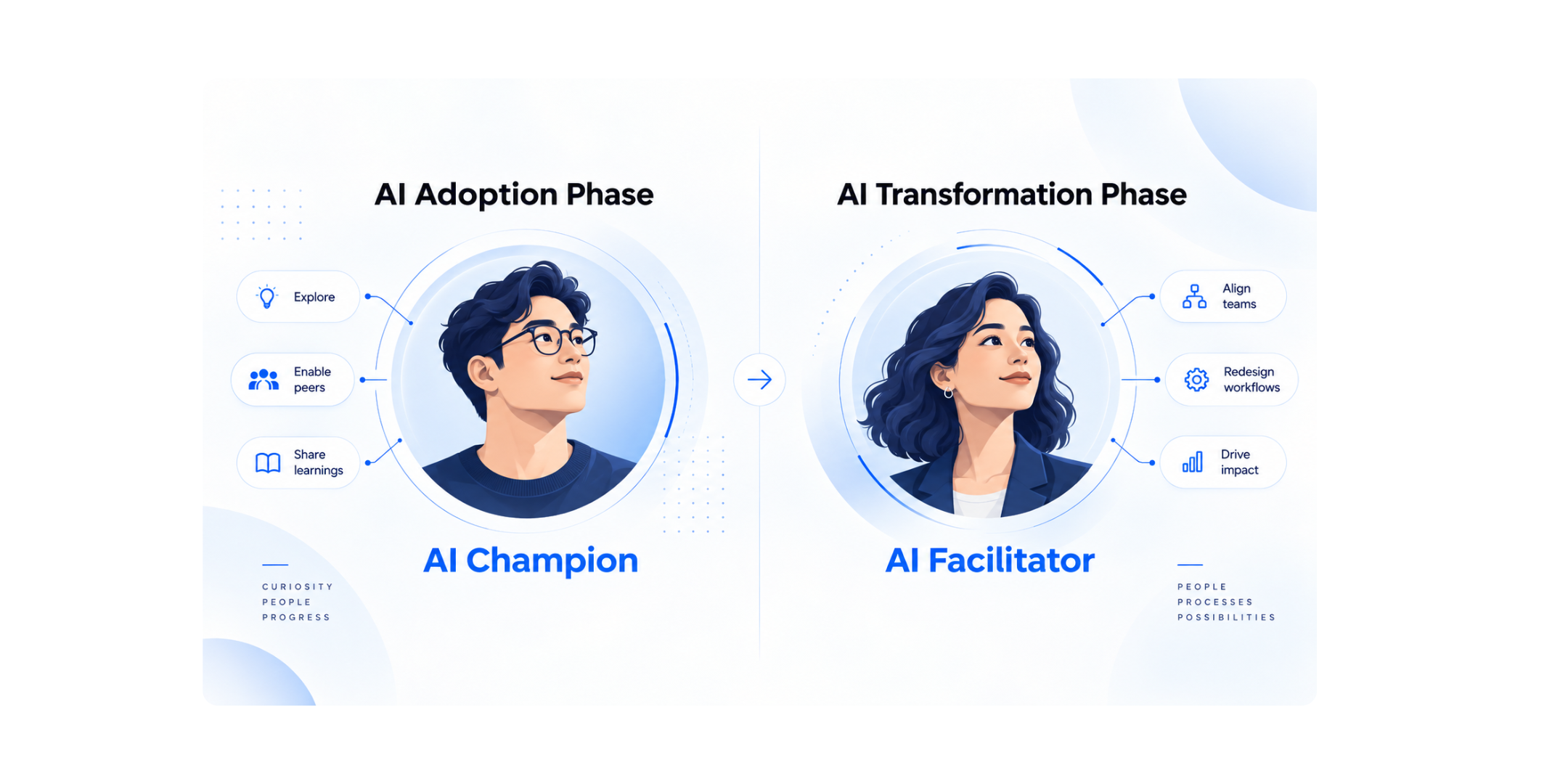
I increasingly think of the traditional role as an AI Adoption Champion.
They help colleagues get comfortable with AI, translate generic training into something useful for their team, answer everyday questions, and keep experimentation moving.
If broad adoption is still the goal, keep investing in them. Adoption is social, and a central AI team will never be close enough to every role, every team, and every small question that determines whether someone actually changes how they work.
The problem starts when the same people are asked to lead changes to how work gets done.
Now the questions sound different.
Which AI opportunities are actually worth pursuing? Where should a workflow change? Why is this process slow in the first place? What should AI do, what should people keep doing, and what needs to change around the handoffs? Who has to agree before any of this moves forward?
Those are no longer tool-support questions. They are questions about how work gets done.
An expense workflow makes the distinction obvious
Imagine a company wants to use AI to reduce the time employees and Finance spend processing expenses.
At first, the opportunities look fairly straightforward. AI can read the receipt, extract the amount, suggest the right category, identify the cost center, and flag unusual spend.
An AI Adoption Champion can help test those things. They can compare tools, improve prompts, check where the output breaks, and help the team work out whether the technology is useful at all.
Good. That is exactly the kind of experimentation we want.
But expenses do not move through one person or one tool.
They move through a workflow involving the employee, their manager, Finance, budget owners, Tax, Compliance, and the systems that eventually reimburse the money.
Once AI starts supporting decisions at several points in that workflow, the questions get harder very quickly.
Who is accountable when the category is wrong? Can a manager approve an expense without Finance reviewing it? Which expenses can go straight through and which ones still need a person? What confidence level is enough to automate a step? Does Tax need to review every international expense? Who defines what counts as suspicious spend? What happens when AI, the manager, and Finance disagree?
And one of my favorite questions: if we make receipt processing much faster, does the overall expense process actually get faster?
You can improve one step dramatically and still leave the approval, policy, or reimbursement bottleneck untouched.
At that point, being good with the AI tool is only one small part of the job. Someone has to help Finance, the business owner, Tax, Risk, and Technology understand the same workflow and make decisions about what should change, where people stay in the loop, and who owns the exceptions.
That is the point where I think the role starts to become something else.
This is where we started using the term AI Facilitator
At Design Sprint Academy, we started calling this person an AI Facilitator about a year ago.
We needed a name for a role we could already see emerging in the work.
Someone had to sit between what AI could do and the people who actually understood the business. AI fluency mattered, of course. But the harder part was getting people from different functions into the same conversation and helping them make sense of the opportunity together.
The AI Facilitator has enough understanding of AI to explore what is realistic. Their real value is in leading the work around it.
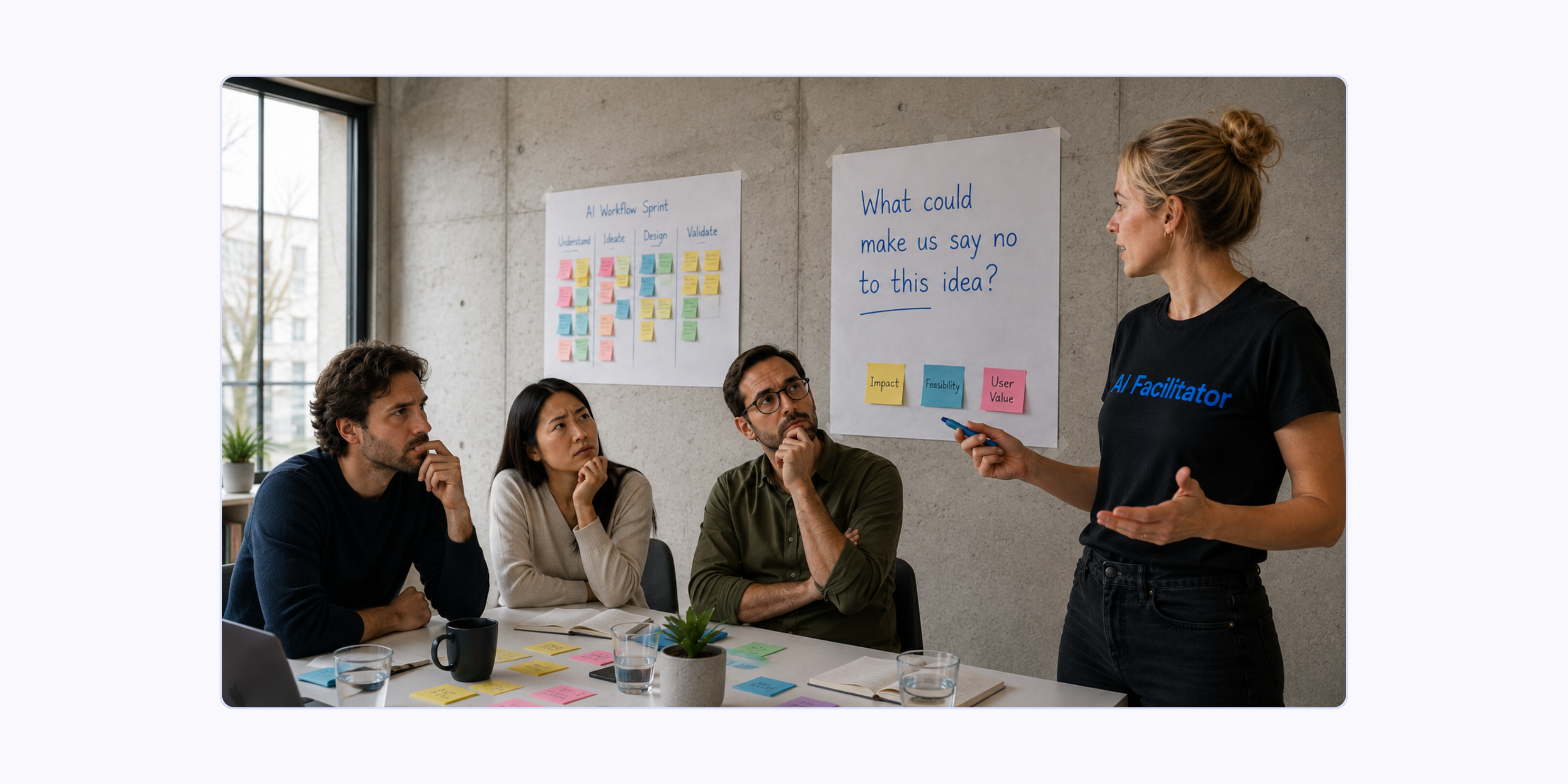
They help a group slow down before everyone jumps to solutions. They frame the business problem. They map the workflow. They surface disagreement that would otherwise stay polite and hidden. They bring the Risk person, the technical expert, and the business owner into the same decision. They notice when a promising AI idea is solving the wrong problem.
And eventually, they help the group decide what happens next.
This is why I see the AI Facilitator as a natural next role for part of an AI Champion network when the organization itself moves from adoption toward transformation.
Your strongest AI user may be the wrong person
This is the part that can make Champion-program design a little awkward.
Companies often choose Champions because they are enthusiastic about AI and already better with the tools than most of their colleagues. During adoption, that is a sensible selection criterion.
Transformation work asks for a different mix of skills.
The person with the cleverest prompts might be terrible at leading a room of six senior stakeholders who all have different explanations for why a process is broken.
A good AI Facilitator has to hear what isn't being said. They have to notice when the group is jumping to a solution because it is easier than agreeing on the problem. They have to stop the loudest person from quietly becoming the decision-maker. They have to help people with very different incentives work on the same question long enough to reach something useful.
That takes training, but more importantly it takes practice on real work.
You can explain a facilitation technique in a classroom. It is different when the Head of Risk and the business owner disagree in front of you and the clock is running.
And then there is the two-hours-a-week problem
A lot of AI Champions are doing this as a side role. They have a full-time job and then two or four hours a week to "do AI."
For adoption, that can be enough to make a meaningful contribution. Share examples. Help colleagues. Join the Champion call. Run a demo or office hour.
Now look at what we sometimes expect from the same person once the transformation conversation starts.
They need to find a worthwhile business problem, speak to stakeholders, understand the workflow, prepare a session, facilitate disagreement, document the opportunity, involve technical teams, follow up with Risk, and get a business owner to make a decision.
That work needs time. It needs a method. It needs support. It needs somewhere to go after the workshop ends.
Calling it a side role does not make the work smaller.
This is one of the patterns I find strangest in enterprise AI right now: transformation-level expectations sitting on top of adoption-level role design.
I don't think Champion networks should disappear
I would keep the Champion network.
In fact, I think many organizations will end up with two distinct jobs inside or around it.
One group remains focused on adoption. They help colleagues use AI confidently and responsibly, share examples, answer the everyday questions, and keep AI literacy alive inside the business.
A smaller group develops into AI Facilitators. They lead opportunity discovery, frame business problems, facilitate workflow redesign, and help cross-functional teams move from "we could use AI here" to a decision the organization can actually act on.
These are two jobs, not two levels of the same job.
That distinction matters when you select people. It also matters when you explain the change to the rest of the network. If "AI Facilitator" sounds like the promotion and "AI Champion" sounds like the role for everyone who did not make the cut, you will devalue the adoption work you still need.
The better question is simply: what does the organization need this person to do?
If the answer is helping colleagues adopt AI, build a strong AI Champions network around that job.
If the answer is leading cross-functional teams through AI opportunity discovery and workflow change, you are asking for facilitation capability, dedicated time, a repeatable method, and a path to people with decision authority.
I suspect a lot of companies do not need to replace their Champion programs. They need to stop stretching one role across two different phases of AI maturity.
The AI Champion was designed to help AI spread through the organization.
The AI Facilitator is emerging because organizations now need people who can help change the work around it.
If your AI strategy has moved on, the role design has to move with it.
And that is a lot to hide inside "two hours a week."