What it actually takes to become an AI Facilitator

What is an AI Facilitator?
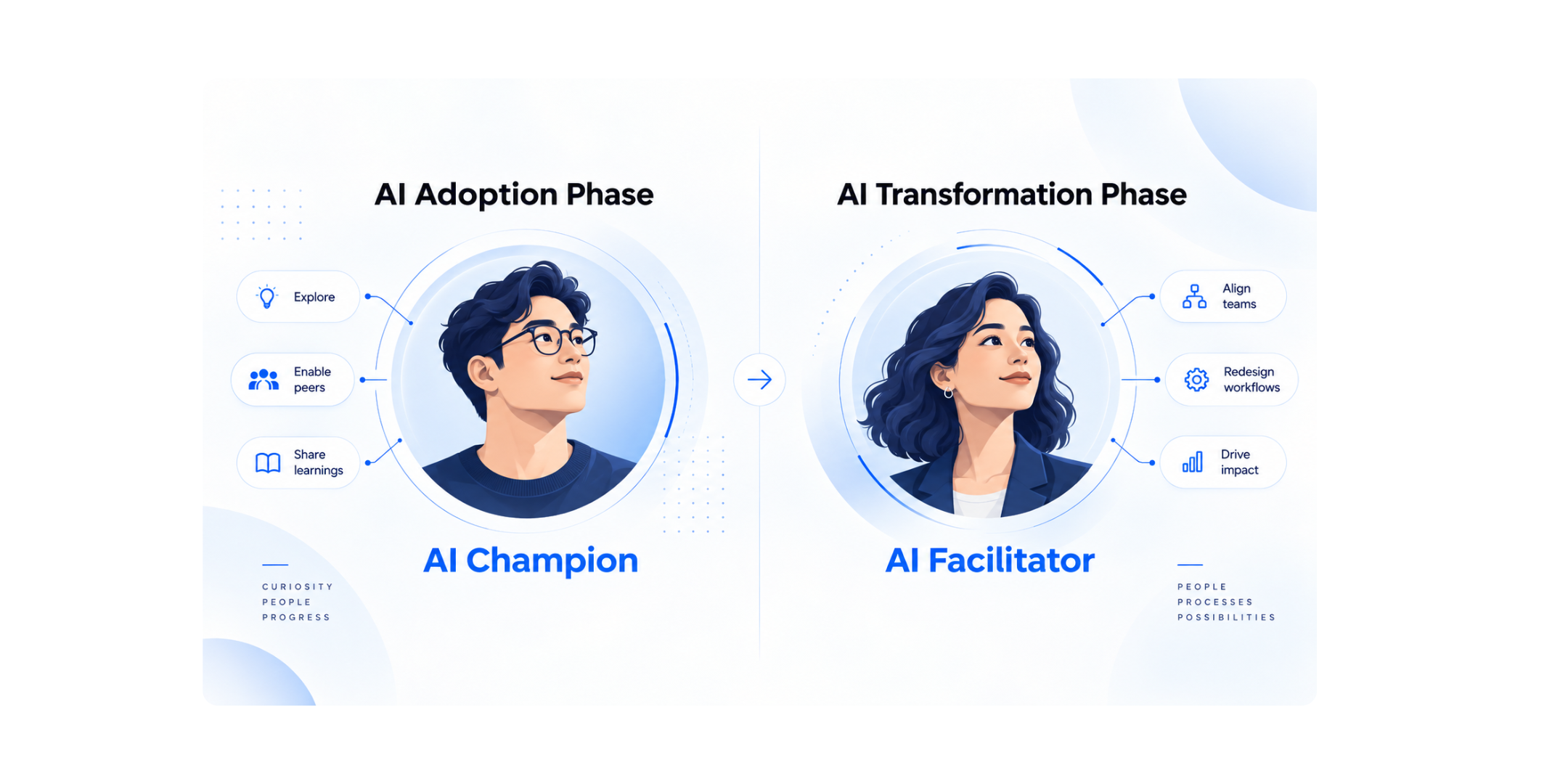
An AI Facilitator is a workshop facilitator who runs cross-functional decision-making sessions inside organizations to turn vague AI mandates into concrete, evidence-based decisions — typically in one to four days.
The role sits between AI strategy and AI execution, and its core skill is process design, not technical AI knowledge.
If you want a fuller picture of what the role involves, this article covers it in depth: What is an AI Facilitator?
Most people who end up doing this work didn't set out to do it. They were a service designer who kept getting pulled into the room where decisions were made and realized that running the room was more interesting than the brief they were brought in for. A Scrum Master whose team had shifted to building AI products and who found themselves running structured sessions on what was worth building, not just how to build it. An innovation manager who noticed their organization had the right people in the room and entirely the wrong conversations. A strategy consultant who wanted to work on something more concrete than slide decks. An AI coach or AI agile coach helping their teams move from experimentation to actual decisions. A learning and development lead being asked to help the business adopt tools nobody had figured out yet.
At some point, they found themselves doing a specific kind of work: getting a room full of people who didn't agree — and often didn't fully understand each other — to a decision they could all stand behind. And they realized this work had a name, a structure, and genuine demand.
If you're at the beginning of that journey — curious about AI facilitation but unsure what it actually involves, whether you have the right background, or how to start — this article is for you.
What does an AI Facilitator actually do?
An AI Facilitator helps cross-functional teams reach a confident, evidence-based decision about AI together — in a defined amount of time, with a specific output at the end.
You don't need to be able to build models, write prompts, or explain how large language models work. The AI knowledge matters, but it isn't the core of the role.
The core is the ability to design and run a structured thinking process for a group of people who could not produce the same output on their own.
In practice, that means running structured workshops with cross-functional teams inside large organizations. The teams are assembled around one AI challenge — a workflow that might benefit from automation, a product idea that involves AI, a strategic question about where AI investment should go. Your job is to take that group from a vague mandate to a concrete, documented decision in one to four days.
The output is a deliverable, not a conversation. A specific AI use case the organization can evaluate and fund. A tested prototype of an AI-powered workflow. A build, iterate, or stop decision grounded in real user evidence. Something the organization can act on.
Who makes a good AI Facilitator?
The strongest AI Facilitators tend to share four traits:
- Comfort with ambiguity. You will routinely walk into rooms where the problem isn't clearly defined, the stakeholders aren't aligned, and nobody knows what success looks like. Your job is to run the process that resolves it.
- The ability to listen across professional languages. The data engineer and the business owner are both right. They just can't hear each other yet. You translate between their ways of thinking until the room arrives at something everyone can stand behind.
- Discipline with process. The method works because the sequence is protected. When the room wants to skip problem mapping and jump straight to solutions — which it always does — you hold the process. Gently, firmly, without apology.
- Curiosity about organizations. AI facilitation happens inside companies with politics, histories, competing priorities, and constrained resources. The more you understand how organizations actually work, the better you become at designing sessions that produce decisions those organizations can act on.
A common assumption worth correcting:
It is not a personality type. You don't need to be the most outgoing person in the room. The quiet, careful observer who notices everything and says little often makes a better facilitator than the naturally charismatic person who fills silence. The job is about design and attention, not performance.
What background do you need to become an AI Facilitator?
There is no single path. The people who do this work well come from design, consulting, learning and development, product management, agile coaching, research, and strategy. What they share is a set of instincts developed through working with groups.
If you have run workshops, led retrospectives, facilitated strategy sessions, or guided teams through decision-making — even informally — you have a foundation to build on. If you haven't, you can build it. The facilitation instincts are developable. They take practice, feedback, and a willingness to be uncomfortable in front of a room until you're not.
The AI knowledge you need is not deep technical expertise. You need enough to understand:
- The difference between AI that automates, AI that assists, and AI that augments human judgment
- What data readiness means and why it matters
- How to recognize when a team is describing a genuine AI use case versus a technology solution in search of a problem
That level of knowledge is accessible to anyone willing to spend time with the right material.
The structured methods — AI Problem Framing, AI Workflow Sprint, AI Design Sprint — are the part you learn formally. These are teachable, and they are learned through doing, not through reading about them.
Who do AI Facilitators work with?
The teams an AI Facilitator runs are called AI Discovery Pods — temporary, cross-functional groups assembled around a single AI challenge. A typical pod includes:
- A Decider (a business owner accountable for outcomes)
- A domain expert who understands the workflow
- A technical lead who assesses what is buildable
- A data engineer who knows what the data can support
- A UX designer
- A legal or compliance voice
- A research or customer success representative
These people may never have worked together before. They speak different professional languages. The data engineer talks in constraints and infrastructure. The business owner talks in outcomes and timelines. The compliance lead talks in risk and liability. The domain expert talks in operational detail nobody else in the room fully understands. They are all describing the same challenge — and they aren't yet hearing each other.
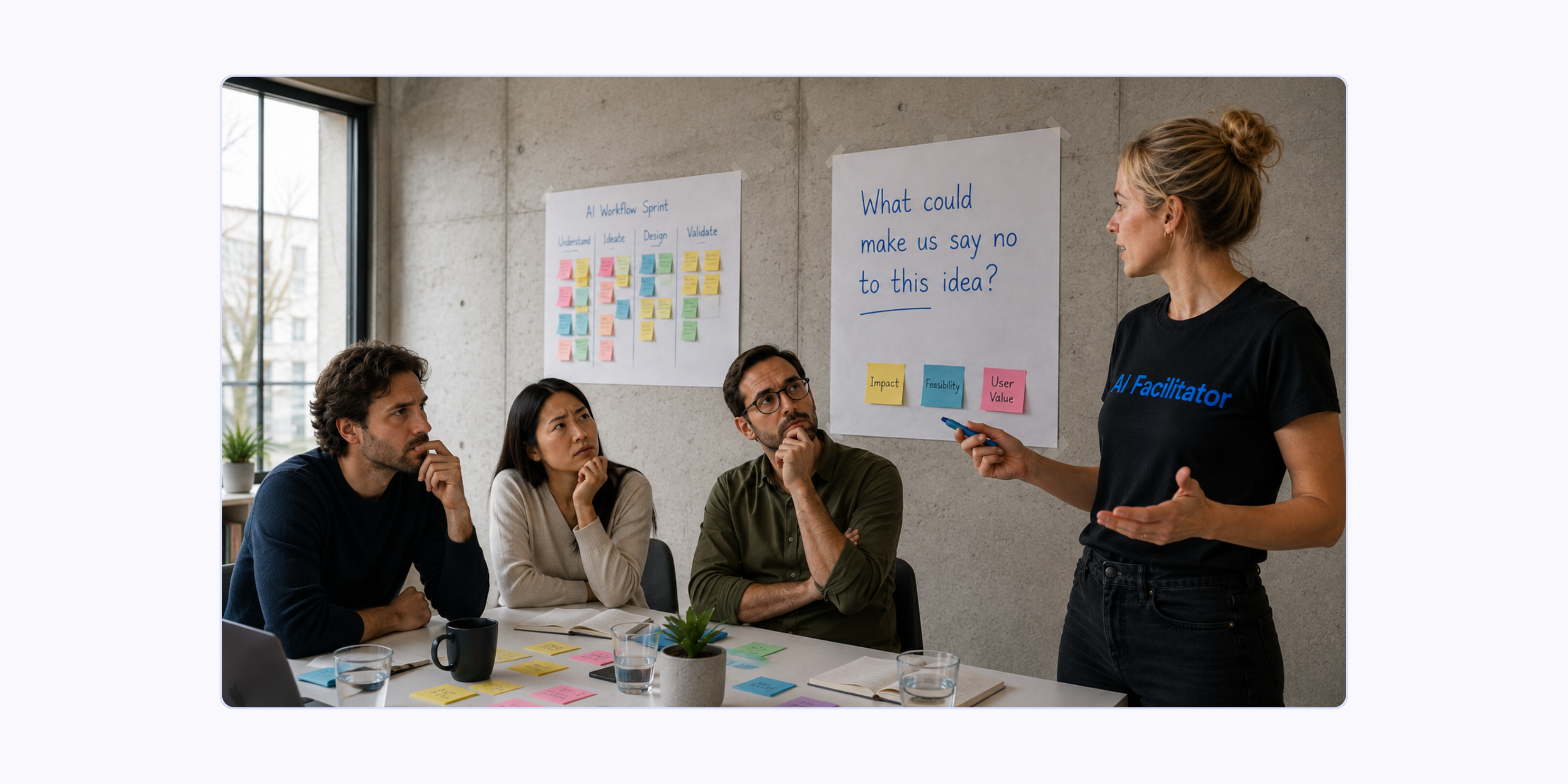
You sit outside the pod. You don't participate in the content of the discussion. You design and run the process that allows the group to think well together — and you protect that process when the room tries to shortcut it.
Your authority comes from the structure, not from seniority or domain expertise. That is one of the things that makes this role genuinely accessible to people early in their career: you don't need to be the most experienced person in the room. You need to be the most prepared.
.png)
What does an AI Facilitator do across a session?
The work has two parts: the part people see, and the part that makes the part they see work.
Before the session
This is where most of the value is created — and where most beginners under-invest. Before anyone enters the room, the AI Facilitator:
- Briefs the Decider separately, before anyone else arrives
- Verifies that the right expertise is in the room for the specific challenge
- Documents the session purpose, the decision to be reached, each participant's role, and what a good output looks like — and sends all of it before people arrive
- Defines exactly what the session needs to produce and confirms the process is designed to produce it
None of this is glamorous. All of it is what separates a session that produces a decision from a session that produces a good conversation.
During the session
You run a structured sequence of activities — each one designed to move the group from a specific starting point to a specific output. Individual thinking before group sharing. Problem mapping before solution sketching. Feasibility assessment before commitment. The activities are not interchangeable. The sequence is not optional.
You also manage the dynamics of the room in real time: the domain expert who dominates, the compliance lead who won't commit, the Decider who keeps looking at their phone, the engineer who has already decided what's buildable before anyone has mapped the problem. These are the moments where your facilitation instincts matter — the ability to read what's happening and respond without derailing the process.
After the session
You produce clean outputs and a clean handoff. The decision that was made. The assumptions that remain open. The next steps and who owns them. A production team should be able to pick up your session outputs and build, without needing to reconstruct the conversation.
What methods does an AI Facilitator run?
Three methods form the core of the AI Facilitator's toolkit. Each one is built for a specific moment in an organization's AI decision-making process.
AI Problem Framing
A one-day session that turns vague AI mandates into specific, fundable use cases. A cross-functional pod evaluates the AI opportunities on the table, stress-tests each one, and converges on a single AI Use Case Card — the one worth pursuing next, with the evidence documented.
It is the session to run when an organization has too many AI ideas and no reliable filter. Read more: AI Problem Framing 101.
AI Workflow Sprint
A four-day session for employee-facing AI. The Discovery Pod works together for the first two days — mapping the current workflow, redesigning it with AI in mind, defining success metrics, and converging on a solution concept. On Day 3, an AI Build Trio (AI Engineer, UX/Product Designer, Subject Matter Expert) constructs a working AI agent MVP. An Interviewer runs structured sessions with real employees on Day 4. The session ends with a scale, iterate, or stop decision from the Decider.
Read more: What is the AI Workflow Sprint?.
AI Design Sprint
A four-day session for customer-facing AI products and services. The Discovery Pod works together for two days. On Day 3, a single Builder constructs a functional prototype of the AI-powered experience. An Interviewer runs structured sessions with real customers on Day 4 — validating the experience before any development begins.
Read more: What is an AI Design Sprint?.
Knowing these methods means knowing what decision each one is designed to produce, what expertise the pod needs, how to prepare the Decider, and how to run each activity in the right sequence. That is learned knowledge — and it is the part of this job that is most directly teachable.
You can also design your own workshop formats from scratch. Some experienced facilitators do, through years of trial and error. At Design Sprint Academy, we built and refined these three methods specifically for AI facilitation — running them across industries, with hundreds of teams. We recommend them because we know what they produce and when to run them.

Why is AI facilitation in demand right now?
Large enterprises are two years into AI investment with portfolios full of scattered pilots, point solutions, and training programs that haven't compounded into anything defensible at board level. They have the technology. They have the teams. What they're missing is the structured decision-making layer that sits between AI strategy and AI execution — the cross-functional process for deciding what is actually worth building, for whom, measured how, with what data, within what governance constraints.
That gap doesn't get filled by hiring more engineers or running more AI training sessions. It gets filled by bringing in someone who can assemble the right people around the right challenge and run a structured process that produces a decision in days rather than months. That is the brief an external AI Facilitator walks in with.
There is a complication worth understanding before you start building your practice: most organizations have not yet figured out how to position the AI Facilitator as a permanent internal role. They know they have a problem. They are not yet convinced enough to hire for it full-time.
Part of this is budget caution after two years of AI investment that didn't deliver the returns promised. Part of it is skepticism built up through failed pilots, disbanded internal AI teams, and consultants who delivered roadmaps and disappeared. Organizations that have been burned aren't in a rush to make another bet they can't defend upstairs. They want proof first — proof that a structured process actually produces different outcomes, proof that the specific outputs are worth the investment, proof that this kind of work is repeatable and not just dependent on one talented individual.
This is actually an advantage for an external AI Facilitator starting out. Organizations in this position are not looking to hire someone permanently yet. They are looking to run one session, see what it produces, and decide from there. That is a great entry point — and if the session delivers a decision the organization can act on, the next conversation is about how many sessions to run next quarter.
The demand is outpacing the supply of people trained to fill it. The market is early enough that positioning matters, and late enough that the clients who need this work know they need it. What they are still figuring out is who to trust with it — and that is the opening.
How do you become an AI Facilitator? A practical path
The path has two tracks that run in parallel: building facilitation reps, and learning the AI-specific methods.
Build facilitation reps in any context you can access
Start getting reps wherever you can find them:
- Offer to facilitate a strategy session or retrospective for a client who wouldn't otherwise pay for a facilitator
- Run a structured decision exercise inside a workshop you're already being brought in for
- Find a non-profit or community group that needs facilitation support
- Co-facilitate with someone more experienced in exchange for feedback and exposure
The reps matter more than the context at this stage. Every session teaches you something a course cannot.
Learn the AI-specific methods
If you want to learn the structured workshops, the preparation discipline, the Decider brief, and the in-session facilitation techniques specific to AI decision-making, the AI Facilitator Training at Design Sprint Academy covers AI Problem Framing and the AI Workflow Sprint in full. Three days, hands-on, built for people who want to do this work and learn it properly.
Expect the in-between phase
There is a phase nobody warns you about. You know enough to run a session, but you don't yet have the track record to charge for it confidently. It feels uncomfortable. It is also completely normal, and it passes.
The way through it is simple: take the work you can get, charge less than you eventually will, and treat every session as practice. You're building two things at once — the skill and the proof that you can deliver. Once you have both, the conversation with clients changes. You stop selling a day of your time and start selling a decision their team couldn't make without you. That is a different conversation — and a different price.
For AI facilitation specifically, that value is easy to make concrete. The cost of a six-month AI pilot that a one-day session could have stopped — or validated — is significant. Organizations understand that calculation. Your job is to show them what the process produces.
The takeaway
The strongest signal that AI facilitation is a real career path is that the work itself is unambiguous: the output is a decision an organization can act on, in days rather than months, on a question that would otherwise stay unresolved for quarters.
The methods are learnable. The role is teachable. The market is early enough that positioning matters and late enough that clients who need this work know they need it.
Everyone who does this work well started somewhere near where you are now. Start with what you can. Build from there.