What no one tells you when you start facilitating AI workshops

Here is what nobody tells you: you are not facilitating a team.
You are facilitating a group of strangers who don't speak the same language.
The data engineer talks in constraints and infrastructure. The business owner talks in outcomes and timelines. The compliance lead talks in risk and liability. The domain expert talks in operational detail that nobody else in the room fully understands. They are all describing the same challenge. They are not hearing each other.
And they have never worked together before. A data engineer who thinks the business doesn't understand what it's asking for. A Decider with forty other priorities who hasn't been told what their role is. A compliance lead who's already decided this is too risky before anyone has said a word. All of them assembled for the first time, around one AI challenge, with one to four days to reach a decision that holds.
No shared history. No established norms. No accumulated trust. Just a room full of people who will disband the moment the session ends.
This is what AI workshop facilitation actually is. And it is fundamentally different from most of the facilitation work you have done before — not because the skills are different, but because the context is. Your ability to read a room, manage competing voices, and get a group to convergence was built in environments where the room already had something in common. Here, the facilitator has to create that common ground from scratch, before the first activity starts, every single time.
This article is about what that actually requires — and what changes when you make the transition.
Your skills are necessary. They are not sufficient.
Everything you know about managing group dynamics, building psychological safety, sequencing activities, and getting a room to convergence — all of it applies. You will use all of it.
But in AI facilitation, you are working in a fundamentally different team structure — one that Amy Edmondson, Harvard Business School professor and leading researcher on organisational learning, calls teaming. Teaming is her term for what happens when people come together fast around a specific challenge, do the work, and then disband. No shared history. No established norms. No time to build either organically.
This is the structure you work in every time as an AI Facilitator. The group you facilitate is called the AI Discovery Pod — a temporary, cross-functional team assembled specifically around one AI challenge. The pod brings together a business owner, a domain expert, a technical lead, a data engineer, a UX designer, a research or customer success voice, and a legal and compliance representative. These people may never have worked together before. They optimise for different goals, speak different professional languages, and will disband once the decision is made.
You do not sit inside the pod. You sit outside it — running the session, managing the dynamics, and protecting the quality of the decision environment. Your authority comes from the process, not from domain expertise or hierarchy.
In a teaming environment, everything that a stable team builds over months has to be deliberately designed into the session before anyone arrives. There is no accumulated shared experience to draw on.
The facilitator creates the conditions for good thinking ahead of time, or those conditions don't exist. That means being more deliberate, more structured, and more explicit than you have probably ever needed to be.
The 1st thing that changes: Pre-session preparation is now your primary job
In most workshop facilitation, a good brief, a thoughtful agenda, and a few stakeholder conversations are enough to walk in well-prepared. The session does the heavy lifting.
In AI facilitation, the preparation work is what determines whether the session can deliver at all.
Before a single person enters the room, the AI Facilitator needs to have answered a set of questions that most workshop practitioners never have to touch.
What is the specific decision this session needs to produce? Not the topic. Not the theme. The decision. An AI Problem Framing session needs to end with one AI Use Case Card — a specific, documented use case the team has agreed is worth pursuing. An AI Workflow Sprint needs to end with a scale, iterate, or stop call from the Decider. If the facilitator can't name the decision before the session starts, the session isn't ready to run.
Who is the Decider, and have they been briefed separately? In a teaming environment, the person with authority to act on the session's outcome needs to understand their role before they walk in. They are not there to watch. They are there to make a call. A Decider who hasn't been briefed delegates, hedges, or defers — and the session produces a recommendation that goes upstairs and dies. The AI Facilitator briefs the Decider one-on-one before the session. Every time.
What expertise does this specific challenge require — and do we have it in the room? The pod composition changes with every challenge. A generative AI assistant for customer service needs different depth than an automation engine for claims processing. The facilitator identifies which voices are essential and surfaces any gaps before the session is scheduled. A well-designed session with the wrong people produces a confident decision based on incomplete understanding. That is often worse than no decision at all.
What do people need to know before they arrive? In a teaming environment, you cannot wait for norms to be absorbed organically. You document everything — the session purpose, the decision to be reached, each participant's role, the expected outputs, the rules of engagement — and you send it before people arrive. The session works better when people show up knowing what they're doing and why, not figuring it out on Day 1.
None of this is rocket science. All of it is work that falls outside the boundaries of what most practitioners currently do. If you want to transition into AI facilitation, this is the first capability to build.
The 2nd thing that changes: You facilitate a process, not a conversation
Most workshop facilitation is conversation-based. You create conditions for good dialogue — safe, balanced, generative. You manage the energy, redirect unhelpful dynamics, and help a group move from divergence to shared understanding.
AI facilitation does all of that. But inside a structured method.
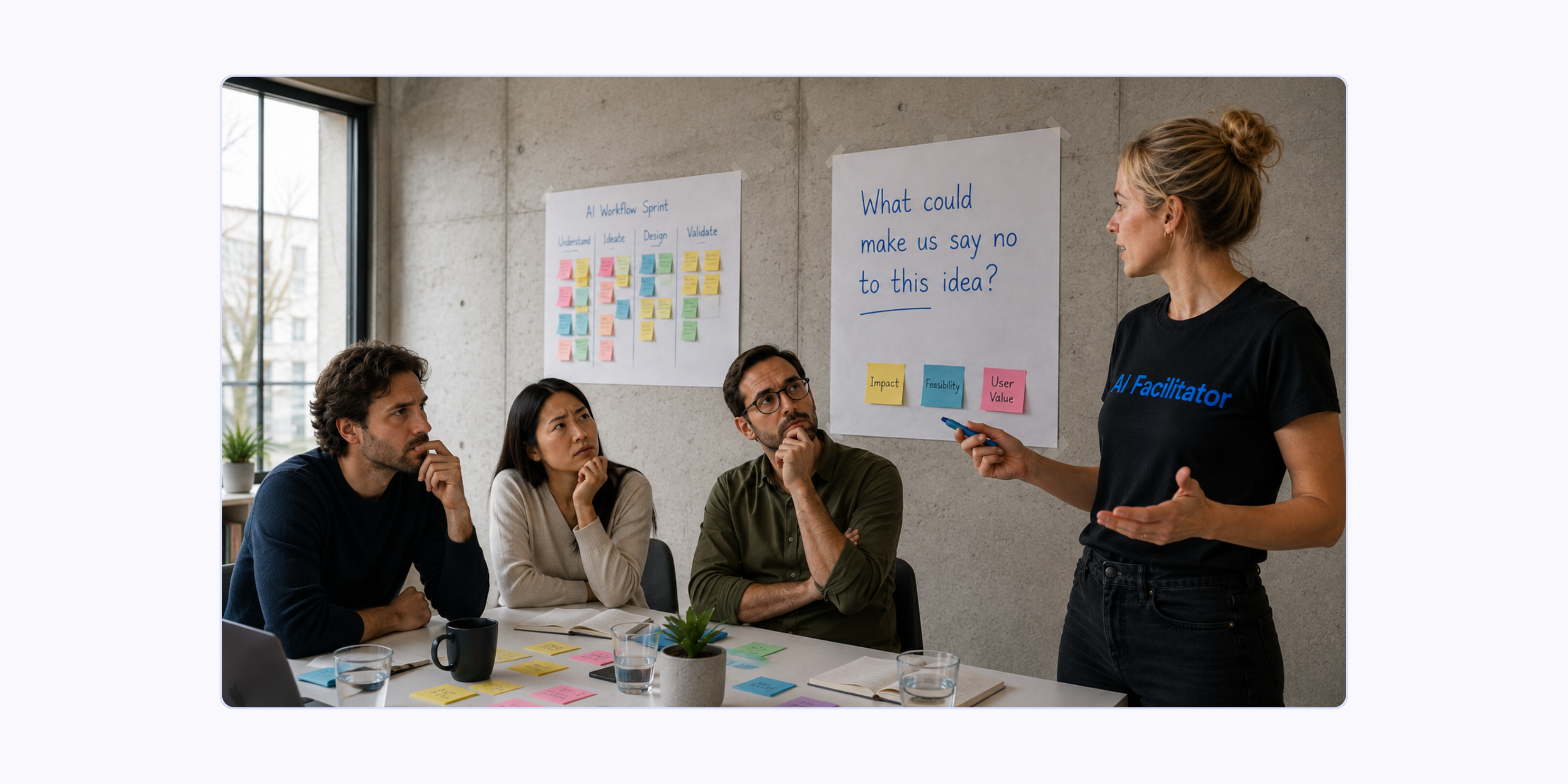
When you run an AI Problem Framing session, you are not designing a bespoke workshop from scratch. You are running a proven sequence of activities — each one designed to move the pod from a specific starting point to a specific output. The activities are not interchangeable. The sequence is not optional. Individual thinking before group sharing. Problem mapping before solution sketching. Feasibility assessment before commitment.
The sequence is what makes the method reliable. The same AI Problem Framing process, run by two different facilitators with different pods, should produce decision-grade outputs in both cases. That reliability is what allows an organisation to build a repeatable AI decision-making capability — rather than depending on whoever happens to be in the room. If the facilitator improvises the structure, the method loses its reliability.
The sequence is also what distributes critical thinking across the room. In standard facilitation, you might assign a devil's advocate — one person whose job is to challenge the emerging consensus. In a structured AI session, that challenge is built into the activities themselves. Risk mapping forces everyone to think about what could go wrong at scale. Feasibility stress-testing forces everyone to assess what the data and infrastructure actually support. And in an AI Problem Framing session, there is a specific tool called the Magic Lenses — drawn from the book Click — that forces the pod to stress-test each AI idea through four distinct business perspectives: Growth (does this open new revenue or market opportunity?), Money (does this create measurable financial value?), Pragmatic (can this actually be built given our current constraints?), and Data (do we have the data to make this work?). Together, they ensure no candidate use case survives on enthusiasm alone.
The facilitator doesn't need one brave person to raise the uncomfortable question. The process creates the moment for it — for every person, every time. Your job is to protect that process. Not to fill it with your own judgment, but to run it with enough discipline that the group's collective judgment can do its work.
.png)
The 3rd thing that changes: Clarity of purpose must happen in the first three minutes
In a stable team, shared context accumulates over time. People know what they're working toward because they've been working toward it together. In a teaming environment, none of that exists. The group has just assembled. Nobody has a shared frame of reference. The context has to be created explicitly, at the start, before any activity begins — because if it isn't, the room will spend the next four hours pursuing different interpretations of the same goal.
This means clarity of purpose — why are we here, what is the shared goal, what does success look like — must be established in the first three minutes. Not as a warm-up. As the foundation on which everything else is built.
For the AI Facilitator, the session opening is not a warm-up. It is the most important moment of the day. You state the sprint goal — what the pod needs to decide by the end of the session. You name what a good output looks like and what it doesn't look like. You confirm that the Decider is in the room and that their call at the end is the call that stands. And you do all of this before the first activity starts.
If this doesn't happen in the first three minutes, the room pursues different goals simultaneously and only discovers the misalignment midway through the session — when it is expensive to correct.
A practical tactic that works: print the workshop objective, the agenda, and the expected output by end of day and display them visibly in the room before anyone arrives. Not on a slide that disappears after the opening. On paper, on the wall, in front of everyone for the entire session. When the room can see where it's going at any moment — what they're working on, what comes next, and what they're supposed to have in hand by 5pm — purpose stops being an abstraction and becomes a shared reference point the group can hold each other accountable to.
The 4th thing that changes: You work with specific methods that build confidence as they run
A general workshop facilitator's toolkit is broad by design. Different methodologies for different contexts. Adaptable, flexible, responsive to what the room needs.
An AI Facilitator works with three specific methods — and knows them well enough to choose between them, prepare them for a specific challenge, and run them with the discipline the method requires.
AI Problem Framing is a one-day session that turns vague AI mandates into specific, fundable use cases. The pod evaluates the AI opportunities on the table, stress-tests each one through the Magic Lenses and feasibility filters, and converges on a single AI Use Case Card — the one worth pursuing next, with the evidence documented. It is the session to run when the organisation has too many AI ideas and no reliable filter.
AI Workflow Sprint is a four-day session for employee-facing AI. The Discovery Pod works together for the first two days — mapping the current workflow, redesigning it with AI in mind, defining success metrics, and converging on a solution concept. A Builder constructs a working AI agent MVP on Day 3. An Interviewer runs structured sessions with real employees on Day 4. The session ends with a scale, iterate, or stop decision made by the Decider based on real user evidence.
AI Design Sprint is a four-day session for customer-facing AI products and services. The Discovery Pod works together for the first two days — defining the AI challenge, mapping the customer journey, generating ideas, and converging on the strongest direction. A Builder constructs a clickable, functional prototype on Day 3. An Interviewer runs five structured customer sessions on Day 4 and presents findings to the Decider. The session ends with a build, iterate, or stop decision.
Knowing each method means knowing what decision it is designed to reach, what expertise the pod requires, how to prepare the Decider, and how to run each activity in the right sequence to get there. That knowledge is learned — it doesn't come from workshop experience alone.
But there is one more thing these methods do that is easy to miss. They are designed to build confidence — not the kind that develops over months of working together, but the kind a temporary team needs to function well in a single session. The confidence that together, this group can actually figure this out.
In a teaming environment, the facilitator has to create that confidence in real time. And the structured sequence of activities is exactly how it happens. Each activity ends with a small win — a dot vote that narrows the options, a selected step on the map, a converged long-term goal, a ranked use case, a chosen solution sketch. The team gets to see themselves make a decision together. Then another. Then another.
Those small wins compound.
By midday, the room has already made six or seven collective decisions. They have been through disagreement and come out the other side. They have heard from the quiet voices and discovered that the compliance lead's concern was actually the most important thing said all morning. They have built a shared frame of reference — not through familiarity, but through the experience of thinking well together.
By the time the Decider makes the final call at the end of the day, it doesn't feel like one person imposing a decision on a group. It feels like the natural conclusion of a process the whole room participated in and trusts. That is what the sequence is designed to produce — not just a decision, but a decision the team believes in.
The transition is closer than you think
All of this — the teaming structure, the preparation discipline, the structured methods, the three-minute clarity — is the learnable part of the job. It can be studied, practised, and built into habit. The methods can be learned. The sequence can be studied. The specific tools can be practised until they become second nature.
What cannot be shortcut is what you already have. The ability to notice when someone has something to say and isn't saying it. The skill of holding a group through the productive discomfort of genuine divergence before pushing for convergence. The judgment to know when to push and when to wait. The presence to redirect a dominant voice without humiliating them. The patience to let the quiet person find their moment. The discipline to protect the integrity of a decision process when the room is under pressure to cut corners.
And the most underrated skill of all: the ability to make problems discussable. To create a container where the thing everyone was avoiding finally gets said — and the group is better for having said it.
These are the things that determine whether a structured method produces a real decision or just a well-run activity. They are also the things that are hardest to teach — and the things you have been building for a while already.
The methods are the learnable part. If you want to learn them in a hands-on training built for practitioners who already know how to run a room, that is what the AI Facilitator Training at Design Sprint Academy is for.