Why AI initiatives need AI Discovery Pods

Do not underestimate the power of the right team.
Organisations that are winning in the AI era are not winning because they have better models, bigger budgets, or more ambitious roadmaps. They are winning because they have teams that know how to think together under uncertainty — teams with the right expertise, the ability to collaborate across disciplines, and the speed to move from a complex problem to a grounded decision before the window closes.
Research on collective intelligence consistently shows that group dynamics can explain up to 40% of the variance in team outcomes, independent of the individual talent in the room. An average team that listens well, integrates different perspectives, and maintains the discipline to test assumptions before committing to them will outperform a room of high-status experts who defend their positions. The difference is not who is in the room. It is how the room works.
This is not just about adaptation. Organisations that know how to assemble and run high-quality collaborative teams for AI decision-making are not playing catch-up. They are setting the pace. They stop weak ideas earlier, validate the strong ones faster, and build the organisational muscle to repeat that process across functions and business units. That compounding capability is what separates organisations that lead from those that follow.
The AI Discovery Pod is the structural answer to this challenge. It is not a standing team or a permanent function. It is a deliberately assembled, temporary, cross-functional group built around one specific AI challenge — with the right expertise, the right tension between perspectives, and a clear finish line. Assembled well and run well, it is one of the most effective tools an organisation has for turning AI ambition into grounded decisions.
This article explains what a Discovery Pod is, why it works, and how to build one that actually delivers.
What is an AI Discovery Pod — and how is it different from a regular team?
An AI Discovery Pod is not a permanent product team. Not a delivery squad. Not a standing committee.
The AI Discovery Pod is a temporary, cross-functional team of 6–8 people, assembled around one specific AI challenge for a defined period. It exists for two things only: Discovery and Proof of Concept.
What makes the Discovery Pod different from a standing team is that it is assembled with purpose and scope in mind. The pod forms around a specific challenge, runs a structured session, produces a decision, and disbands. Nobody is joining a committee.
The session the pod is assembled for depends on where the organisation is in its AI journey:
If leadership has identified an AI opportunity and the organisation needs to decide which specific use case to pursue, the pod assembles for an AI Problem Framing session — one focused day to evaluate the candidates, stress-test assumptions, and produce a single AI Use Case Card that tells the team what to build next and why.
If the team has a validated AI use case and needs to redesign a workflow and build an AI agent to support it, the pod assembles for an AI Workflow Sprint — two days for the Discovery Pod, followed by one day for a Builder and one day for an Interviewer who tests the prototype with real employees. The pod's commitment is two days.
If the team needs to validate a customer-facing AI product or service before committing to development, the pod assembles for an AI Design Sprint — again two days for the Discovery Pod, followed by a Builder and an Interviewer who runs five structured customer sessions. Same structure, different focus: customer experience rather than employee workflow.
In each case, the pod hands off its outputs when the session ends. Production teams take over from a position of evidence, not guesswork. The pod borrows from the idea of small, cross-functional units built for complex digital challenges — adapted for early AI work where speed and shared understanding matter more than scale.
Why AI initiatives fail without cross-functional structure
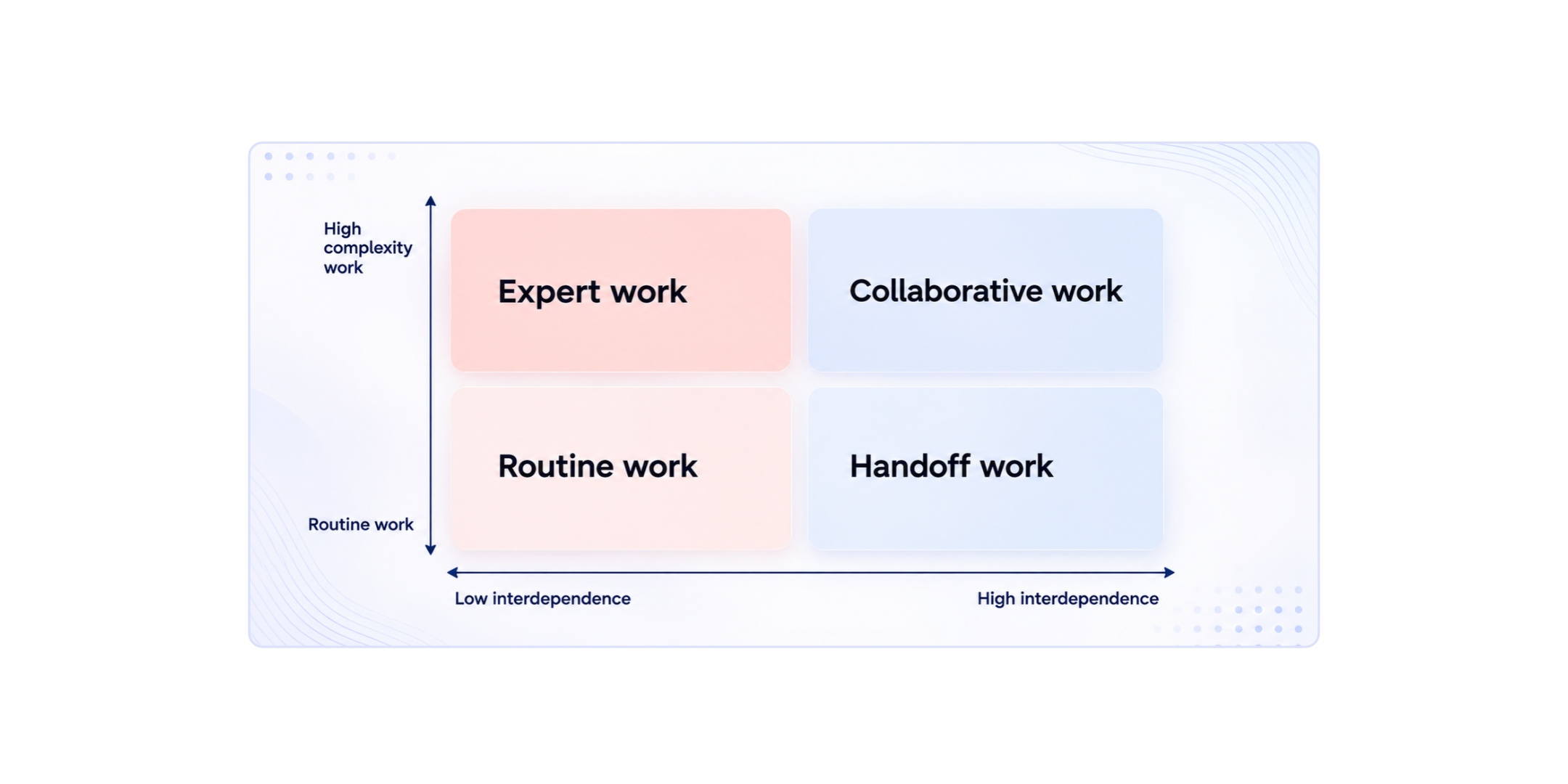
AI initiatives are structurally different from most product work, and that difference is what makes the standard team setup struggle.
AI problems cut across data, technology, legal, and operations — often simultaneously. They introduce regulatory and trust risks that don't fit neatly into any one function's remit. And they surface unexpected constraints at unpredictable points: data that looks clean isn't, a feasibility assumption that seemed safe turns out to be wrong, a compliance question that nobody raised in the planning meeting becomes the blocker on Day 3.
Trying to handle that in sequence — brief the data team, wait for their findings, brief legal, wait for their view, brief engineering — turns into a calendar of meetings that still doesn't answer the key questions. By the time everyone has weighed in separately, the assumptions have changed and the conversation has to start over.
The alternative is simpler: get the right people in the same room, working on the same problem, at the same time, with a clear finish line. That's the Discovery Pod.
The pod exists for discovery and PoC — nothing more
This constraint matters more than it might seem.
The pod's job isn't to ship. It's to choose AI use cases worth solving, build and test prototypes with real users, and prove or disprove desirability before serious resources are committed. Decide early with evidence — or don't build.
When the pod loses this constraint — when it starts being treated as a delivery team, or a standing resource, or a group that handles all AI questions that come in — it loses the focus that makes it work. If everything gets a pod, the pod becomes another meeting.
.png)
Who belongs in the pod
The ideal composition for an AI Discovery Pod at this stage brings together seven roles:
- Product Manager or VP of Product (Decider) — owns the challenge and the accountability. Makes the final call on what to build, iterate, or stop.
- Domain Expert — understands the workflow or problem space being addressed. Brings the operational reality that makes AI solutions viable or exposes them as impractical.
- AI or ML Engineer — assesses technical feasibility, model options, and capability limits.
- Data Engineer — checks data access, quality, and pipeline realities. Often the person who knows earliest whether an idea is actually buildable.
- UX Designer — translates the solution concept into something people can interact with. Brings the user experience lens to every design decision and leads the prototype work.
- Research or Customer Success — brings the user's reality into the room. The voice that keeps the team honest about what people actually need and how they actually work.
- Legal and Compliance — flags constraints and red lines early, before they become expensive surprises.
- Business or Process Analyst — ties AI ideas to real workflows and business value. Keeps the conversation grounded in what the organisation can actually use.
A few principles that matter more than titles. Everyone in the pod is fully committed on workshop days — not split across three other priorities. In-person is strongly preferred, especially at this stage, where shared context builds faster when people are in the same room. And the group should be a deliberate mix of backgrounds and thinking styles, not just the most senior people available.
This mix works because it creates the productive tension the work needs: feasibility meets imagination, risk meets ambition, domain knowledge meets adjacent perspectives that aren't constrained by past attempts.
What the AI Facilitator owns
A well-composed pod is necessary but not sufficient. You can assemble the right people, clear their calendars, and put them in a room together — and still end up with competing agendas, an AI engineer who dominates the conversation, a legal lead who raises every concern too late, and a Decider who wasn't properly briefed and can't make a confident call at the end. The people in the room are not enough on their own. The room needs to be run.
That is the AI Facilitator's role.
The AI Facilitator is a trained practitioner who runs structured AI decision-making sessions — AI Problem Framing, AI Workflow Sprints, AI Design Sprints — and knows how to get a cross-functional team from a complex, ambiguous challenge to a clear, evidence-based decision in a defined number of days.
They are not a domain expert, a project manager, or a business consultant. They are a process specialist. Their expertise is in designing the conditions that allow a group to think well together, not in having the best answer themselves.
Critically, the AI Facilitator is not a member of the Discovery Pod. They sit outside it. This distinction matters more than it might appear. A facilitator who is inside the team has a stake in the outcome — their ideas compete with others, their instincts shape which directions get explored, and their position creates subtle pressure on how the group moves. A facilitator who sits outside the team has only one job: to make the process work. Their authority comes from the process, not from hierarchy or expertise. That neutrality is what allows them to manage group dynamics honestly, surface the tensions the team is avoiding, and protect the quality of the decision environment.
In practice, the AI Facilitator designs the decision flow before anyone enters the room — which activities run in what sequence, what outputs each stage must produce, and how the session connects to the handoff that follows. They prepare the context so the pod starts aligned rather than spending the first hours reconstructing shared understanding. They guide the group through each stage, bring in the right voices at the right moments, and keep the session moving without letting any single perspective dominate.
They also protect against the two failure modes that most often derail AI discovery work. The first is status battles — where the most senior or most confident voice in the room shapes the conclusions regardless of what the evidence says. The second is AI hype — where enthusiasm for what AI could theoretically do overrides an honest assessment of what it can actually do here, with this data, for these users, in this organisation. Both are subtle. Both compound over time. Both are significantly harder to correct after the fact than to prevent in the session.
Most importantly, the AI Facilitator ensures the pod ends with clean outputs and a clean handoff — documented decisions, tested assumptions, open questions named and owned. Without that discipline, the session produces useful thinking that doesn't survive contact with the production team that has to act on it.
Without a facilitator, Discovery Pods tend to become debates. With one, they become decision engines.
How to assemble an AI Discovery Pod
Assembling a Discovery Pod looks like a logistics problem. In practice it is a strategic one. Getting it right requires three things to happen in the right sequence: the right problem, the right people, and the right conditions for those people to show up.
1. Start with the problem — and make sure it's worth a pod.
Not every AI challenge deserves a Discovery Pod. This is the wrong tool for small backlog items, low-risk tweaks, or problems that one person with the right context can resolve in an afternoon. The pod is designed for challenges that are genuinely complex and still undefined, high-risk in terms of trust, compliance, or operational consequences, and strategically important enough that a wrong decision is expensive. A good problem for a Discovery Pod is one that sits across multiple functions, has no obvious owner, and can't be resolved without different kinds of expertise in the same room at the same time.
The problem also needs to be connected to something the organisation already cares about at the top — an OKR, a board priority, a cost or revenue goal with a name and an owner. An interesting AI opportunity that isn't tied to a strategic goal produces a validated use case that nobody has budget or mandate to act on. The AI Facilitator maps the expertise the session needs. The leader's job is to confirm that the problem connects to something real before the pod is assembled.
2. Map the expertise the challenge actually requires.
The composition of the pod is not a fixed template. It is a deliberate response to the specific challenge being addressed. A generative AI assistant for customer service requires different depth than a decision-support system for underwriting or an automation engine for claims processing. The balance between ML and data engineering shifts. The weight given to UX versus workflow design changes. The degree of compliance involvement from day one varies significantly.
Before the pod is assembled, the AI Facilitator should work with the leader to identify which voices are essential for this specific challenge — the domain expert who understands the workflow intimately, the technical lead who can assess what is actually buildable with the data that exists, the compliance voice who defines the boundaries early rather than raising them as blockers on Day 3. Generic roles lead to generic outcomes. The pod needs the right people for this problem, not the standard seven roles filled by whoever is available.
3. Balance problem veterans with fresh thinkers.
Once the essential expertise is mapped, there is a second layer of composition that matters and is often overlooked: the balance between people who know the problem deeply and people who don't.
Problem veterans — the domain experts, the operations leads, the people who have lived with this challenge for years — bring irreplaceable context. They know what has been tried, where the data is weak, what the constraints actually are in practice rather than on paper. Without them, the pod loses touch with reality fast.
But a room full of problem veterans also carries the weight of accumulated frustration and prior failure. They have been around long enough to know why things don't work, and that knowledge can foreclose exploration before it starts. "We've tried this." "That won't scale here." "Legal will never approve it." These reactions are often right — but they arrive too early, before any concrete idea has formed, and they shut down the search for better options before it has properly begun.
Fresh thinkers — people with adjacent expertise, practitioners from different industries, or simply people who haven't spent three years on this specific problem — bring a different kind of value. They don't carry the scar tissue of past attempts. They ask questions that seem naive but surface assumptions the veterans stopped questioning. They propose directions that sound unrealistic until someone with constraints knowledge finds a version that works. They move faster because they are not slowed down by institutional memory.
The AI Facilitator's job during assembly is to look at the proposed pod and ask: where is this room going to get stuck? If the answer is "it won't — everyone here already agrees on the direction," the pod probably needs more tension, not less. If the answer is "it will collapse into constraints before anything is generated," it needs more openness. That diagnosis shapes who gets added and how the session is designed to manage the energies in the room.
4. Understand that expertise and availability are different things.
The people who most need to be in the room are almost always the people who are hardest to get there. They have targets to hit, pipelines to manage, and leaders to answer to. Discovery is not on their job description. Nobody volunteers four days — or even two — away from their delivery commitments for a session their manager hasn't sanctioned.
This is where the leader's role becomes essential. The AI Facilitator can identify who is needed. They cannot compel those people to participate. That requires a direct conversation between leaders — not an email from the facilitator, not a calendar invite, but a peer-to-peer commitment grounded in a shared goal. The conversation works when both leaders recognise that the challenge sits across their domains and that solving it well benefits both of them. One leader calls their peer: this challenge affects both our teams, I need your data lead in the room for two days, I'm asking you directly. That conversation gets the right person. The facilitator's invitation gets a delegate.
One thing that makes the ask easier: the Discovery Pod is temporary by design. It assembles around one specific challenge, produces a decision, and disbands. Nobody is joining a committee. The commitment is bounded — one day, two days, or four — and then it's done. That is a manageable ask for a busy senior person. But it still requires their leader to sanction it.
5. Be explicit about the life stage before anyone enters the room.
The pod exists for discovery and proof of concept only. That means the goal must be stated clearly before the session begins: evaluate the AI use cases on the table, identify the one worth pursuing, and validate it with real users before any production investment is made. If the team isn't aligned on this before they start, the session drifts into solution-first thinking or architecture debates before anyone has established what the problem actually is. The AI Facilitator's job is to ensure that alignment exists. The leader's job is to reinforce it — making clear to every participant that this is a discovery process, not a delivery kickoff.
6. Plan the handover before the pod starts.
The pod is temporary. That means the outputs need to travel — from the people who were in the room to the production teams who weren't. The AI Facilitator's preparation work includes being clear on what gets documented, which assumptions were tested and what the results were, which decisions were made and by whom, and which questions remain open. Without that clarity, production teams spend their first weeks reconstructing intent rather than acting on evidence.
The point of the pod
The organisations that will lead in the AI era are not the ones with the most ambitious strategies or the largest AI budgets. They are the ones that have built the organisational capability to make good AI decisions repeatedly — to assemble the right people quickly, run a structured process that produces real evidence, stop what doesn't work before it becomes expensive, and advance what does with the confidence that comes from having tested it.
That capability does not emerge on its own. It is built deliberately, one well-run session at a time. The Discovery Pod is the unit that makes it possible: temporary enough to respect the constraints of a real organisation, focused enough to produce a decision rather than a discussion, and designed with enough care for composition and facilitation that the thinking in the room is genuinely better than what any individual could produce alone.
Built well and run well, a Discovery Pod does more than validate an AI use case. It builds the muscle. The team that has been through a well-facilitated AI Problem Framing session approaches the next challenge differently. The leader who has watched a structured process produce a clear, evidence-based decision in two days starts to understand what is possible when the right conditions are in place. That understanding compounds.
The Discovery Pod is not designed to operate in isolation. At scale, it is one working unit inside a larger system — the AI Lab. The AI Lab is the organisational design that allows Discovery Pods to run repeatedly and consistently across business units: a structured cadence of sessions, a shared intake process for AI ideas, a common vocabulary, and the metrics to track whether the system is producing real decisions or just activity. Individual pods produce individual decisions. The AI Lab turns that into an organisational capability. The pod is where the work happens. The Lab is what makes it repeatable.
The organisations that figure this out early — that invest in assembling the right teams, running them well, and protecting the discipline that makes the process work — are not just adapting to the AI era. They are shaping it.

.png)