How AI Workflow Sprints can get HR unstuck

Be efficient. Cut costs. Adopt AI.
Three things that keep HR leaders up at night — not because they're impossible, but because the pressure arrives without a path.
To understand why that path keeps disappearing, it helps to think about how organizations have actually moved through AI — not as a technology roadmap, but the way humans grow up.
It started with exploration. Like a baby pressing every button without fear of consequences, organizations bought licences, played with prompting, created fun things, and discovered what AI could do. Zero commitment. Pure curiosity. That was the right response at the time.
Then came structure. Like a school-age child learning systematically, organizations started building discipline around AI. Prompt libraries. AI guidelines. Skills courses. First attempts at governance. The wild energy of discovery got organized into something more intentional.
Then came adolescence. A teenager explores independence — acts with confidence, but not always with full understanding. This is where most organizations spent 2024 and 2025. AI pilots. AI initiatives. Shadow AI spreading through teams faster than governance could follow. Isolated wins. Scattered direction. Confidence growing faster than clarity.
And now comes the hard part.
Adulthood means responsibility. It means being expected to deliver, not just experiment. The question in adolescence was "What can we do with AI?" The question in adulthood is "What did AI actually change — and what did it cost?" Pilots need to produce results. Investments need a clear answer: scale, iterate, or stop.
In 2026, organizations are expected to grow up. And HR — the function given the mandate to transform how work gets done — is feeling that expectation more directly than almost anyone.
The problem is that most HR teams are still using adolescent methods to solve adult problems. Two years of activity. Plenty of enthusiasm. And results that haven't compounded into operational change.
Not because the ambition was wrong. Because the work keeps stalling in the same places.
The patterns that keep HR stuck
Research consistently shows that around 75% of HR teams are still in the early stages of AI adoption — experimenting, piloting, exploring — without moving into something that changes how the function actually operates.
The blockers are almost entirely human.
Efforts stay fragmented. AI experimentation happens person by person, team by team, with no shared structure connecting the insights. One team builds a screening tool that works for them and never tells anyone. Another starts from scratch six months later. Enthusiasm grows; results don't compound. Leadership asks for an update. The answer is complicated.
AI gets added onto workflows that were never redesigned. The most common mistake is treating AI as a speed layer on top of existing processes. But if the workflow is inefficient, built around outdated assumptions, or quietly broken in ways that only the people doing the work can see — AI doesn't fix it. It accelerates the same problems at higher speed.
HR and technical teams can't quite find each other. Even when data scientists and engineers are available and willing, the collaboration breaks down. HR can't always translate operational needs into the specific, scoped problems that technical teams can act on. Technical teams can't always understand which outcomes actually matter to the business. The result: misaligned priorities, late-stage surprises on compliance and governance, and an HR function that ends up dependent on external vendors rather than owning anything it built.
These patterns reinforce each other. And they don't resolve on their own — because the issue isn't capability, it's the absence of a shared structure for moving from experiment to decision.
What an AI Workflow Sprint does differently
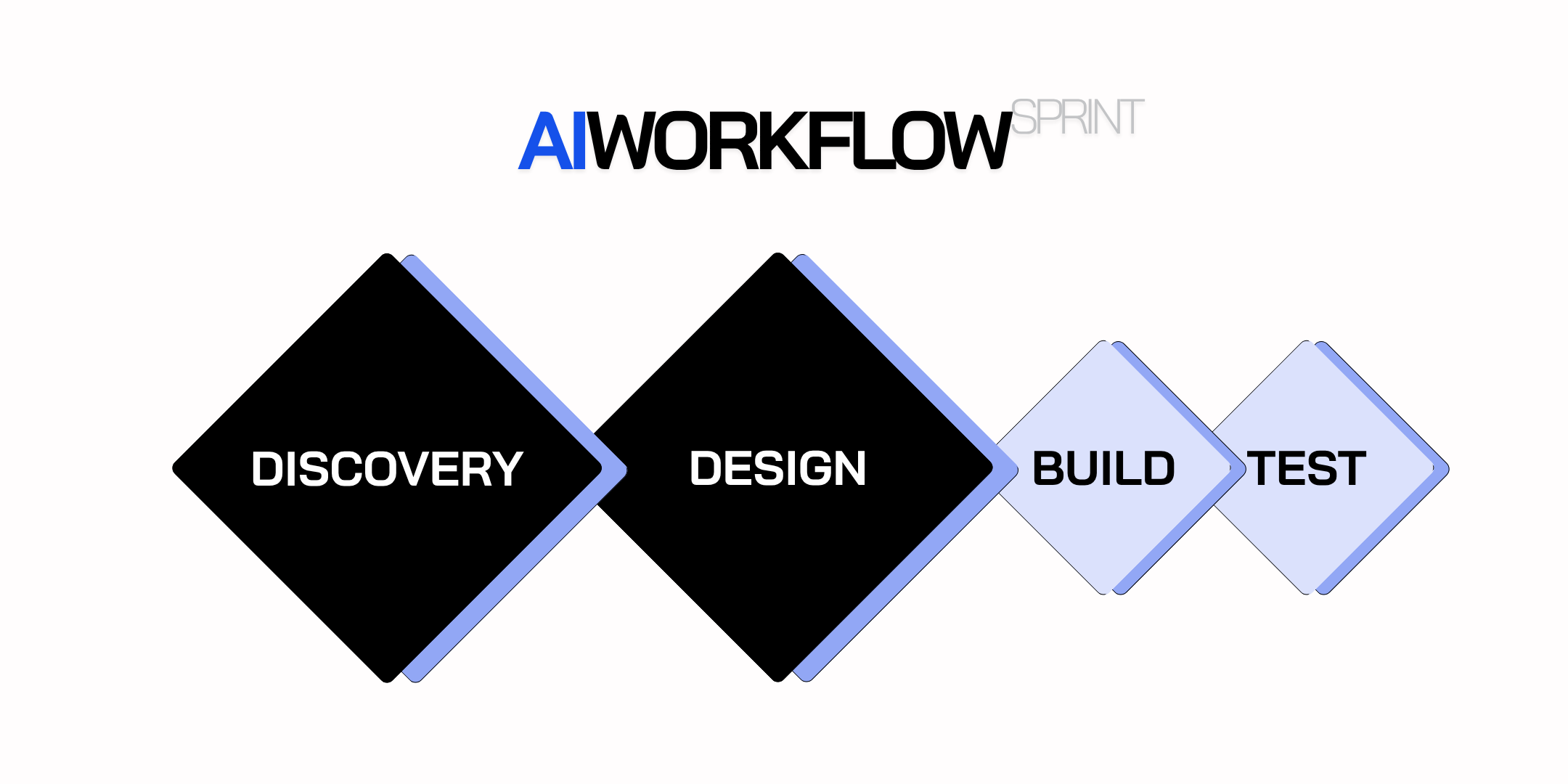
An AI Workflow Sprint is a four-day facilitated process that takes a cross-functional team from a validated AI use case to a tested prototype and a clear, evidence-backed decision.
It isn't the beginning of the AI journey. It's the method that makes the next step executable. The upstream work — identifying which workflow is worth redesigning and why — happens before the sprint through a process like AI Problem Framing. The sprint picks up from a validated use case and takes it somewhere real.
What it produces addresses each of the patterns that keep HR stuck — not by resolving them in theory, but by designing around them.
The fragmentation problem is solved because the sprint is a contained, cross-functional process with a shared sequence. HR practitioners, technical teams, legal, and the employees who actually do the work move through the same problem together, in the same room, in the same order. What gets learned is shared immediately, not siloed.
The workflow redesign problem is solved because the sprint explicitly doesn't start with AI. It starts with the employee — their context, their pressures, the actual steps of their work as it exists today. The team maps the current workflow, identifies where it breaks down, and redesigns it before any AI is introduced. Only then does the group look for where AI creates real leverage. This sequence alone changes what gets built — and prevents the mistake of automating a broken process.
The collaboration problem is solved because the sprint provides the shared structure that HR and technical teams have never had. HR doesn't need to become technical. The format creates a process that both sides can work through together — one that translates operational needs into design decisions, and technical possibilities into workflow improvements that HR can evaluate and own.
By the end of four days, the team has a tested AI prototype, measurable success metrics agreed before building began, and a decision backed by evidence from real employees. Scale. Iterate. Stop.
A Stop isn't failure. It's the sprint doing exactly what it was designed to do: surface the truth about a use case before months of engineering resources are committed to building it. In 2026, when every AI investment is being measured, a well-evidenced Stop decision is not a setback. It's the kind of disciplined clarity that builds credibility with leadership rather than eroding it.
What changes for the HR Leader
The shift isn't just operational. It's strategic.
An HR leader who can run an AI Workflow Sprint — or bring the method into the organization — stops managing AI confusion and starts producing the evidence that moves AI from experiment to practice. They become the function that turns a validated use case into something built, tested, and decided upon — before a single engineering sprint is committed.
That is a different position inside the organization than the one most HR teams currently occupy.
The mandate — help the organization transform how work gets done — stops being a pressure without a path. It becomes an executable method, with a clear starting point, a four-day structure, and an outcome that the executive team can actually act on.
That's what adulthood looks like for HR and AI. Not more experiments. The structure that makes them count.
Three ways to get started
There is no single right entry point. Where to begin depends on how much clarity already exists and how much urgency is coming from above.
1. Experience it before you run it.
The lowest-risk, lowest-investment entry point is to go through the process yourself — or send someone you trust as a proxy. Most organizations that now run AI Workflow Sprints internally started exactly this way: one person attended the training, understood the method from the inside, and came back with the confidence and language to introduce it. No internal buy-in required upfront. No large commitment. Just direct exposure to how it works — and what it produces. Explore the AI Workflow Sprint Training →
2. Prove it works — bring in a neutral, expert facilitator.
The most credible way to demonstrate the value of this method to leadership is to run a real sprint on a real workflow, with a neutral external facilitator who has no stake in the outcome. This is not about outsourcing the work. It is about removing the internal politics that cloud the room — so the team can focus on the problem instead of managing dynamics. A well-facilitated pilot produces a tested AI prototype and a decision backed by user evidence. It also gives the internal team a reference point: this is what good looks like. Book a call to explore AI Workflow Sprint facilitation →
3. Build internal capability — and run it as an AI Lab.
But not the kind of AI Lab most people picture.
Not a Center of Excellence with a permanent headcount and a innovation mandate that slowly drifts from the business. Not a team of data scientists in a room building prototypes that never reach production. Not a demo factory. And not another committee that meets monthly to review AI ideas.
The two failure modes those structures tend to produce have names: AI theatre — demos, pilots, excitement, no adoption — and AI lockdown — governance panic, restrictions, no progress. HR leaders have seen both.
An AI Lab, the way it actually works, is operating infrastructure. Trained AI Facilitators who can run structured discovery. Small, temporary Discovery Pods assembled around one specific business goal — not permanently staffed, spun up when needed and disbanded once the decision is made. And a repeatable 2-day cadence that takes each pod from a vague opportunity to a tested concept and a clear build / scale / stop call.
Then the same thing happens in a different business unit. And another. Not a one-off initiative. A system that runs.
For HR, this is what it looks like to stop being the function that manages AI confusion and become the function that owns the process for deciding what gets built. Learn more about AI Labs →
These are not competing options. Most organizations move through all three — building understanding first, proving it with a facilitated pilot, then owning it permanently through internal capability.