
Facilitator Kits
.png)

A four-day structured process. A cross-functional team — the people who do the work, the people who know the technology, and the people who own the decision — maps how a specific workflow runs today, redesigns it around AI capabilities, builds a working prototype, and tests it with real employees. The AI Facilitator runs this process.
A step-by-step facilitation manual for all four days — Discovery, Design, Build, and Test. Every activity explained, every output defined, and notes on what breaks down and how to handle it. Written by John and Dana Vetan from running this process with real teams.
.png)
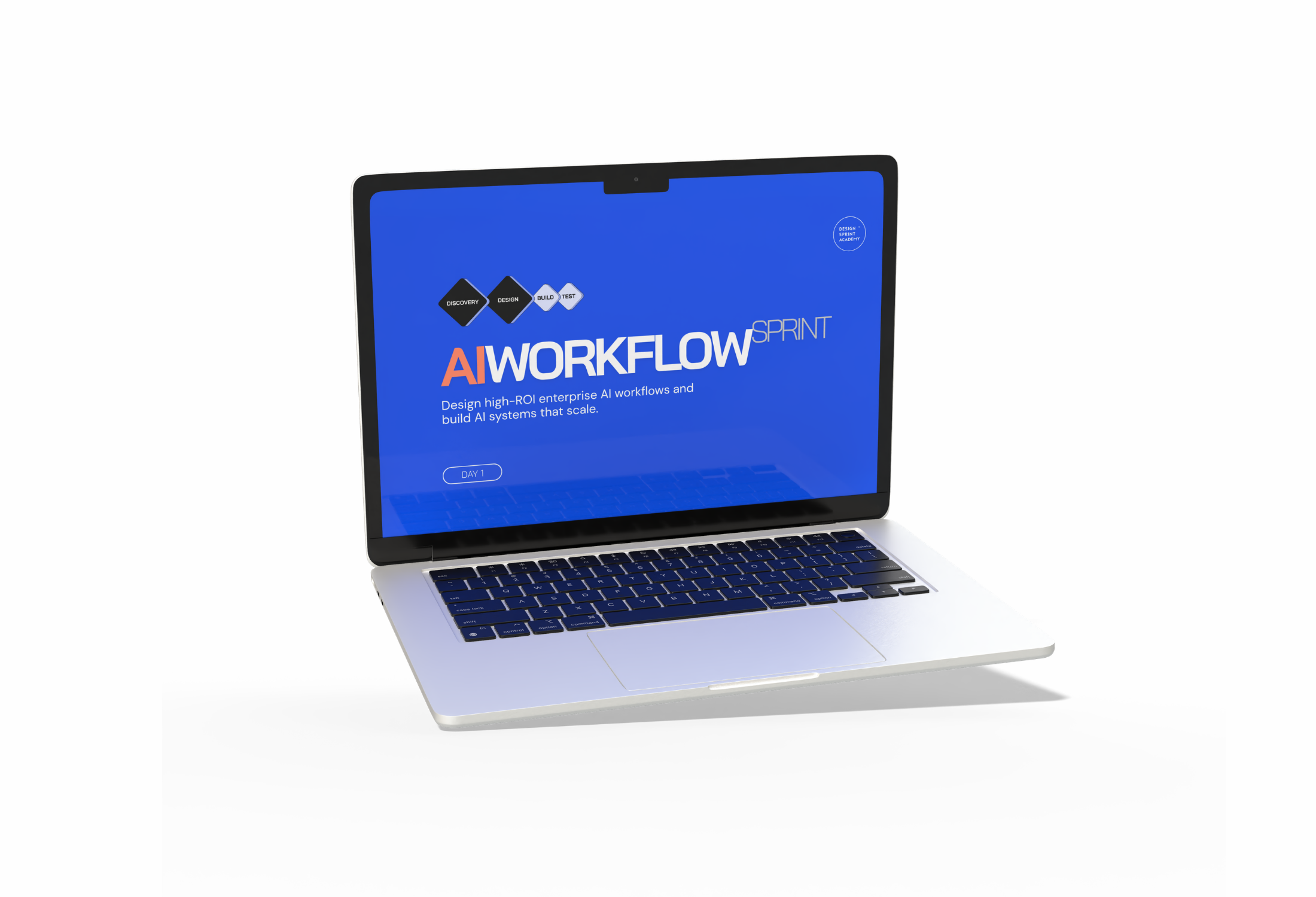
A session-ready deck for each day. Every slide introduces the activity, shows the instructions, and sets the pace. The slides are your script. Fully editable so you can brand them for your clients.
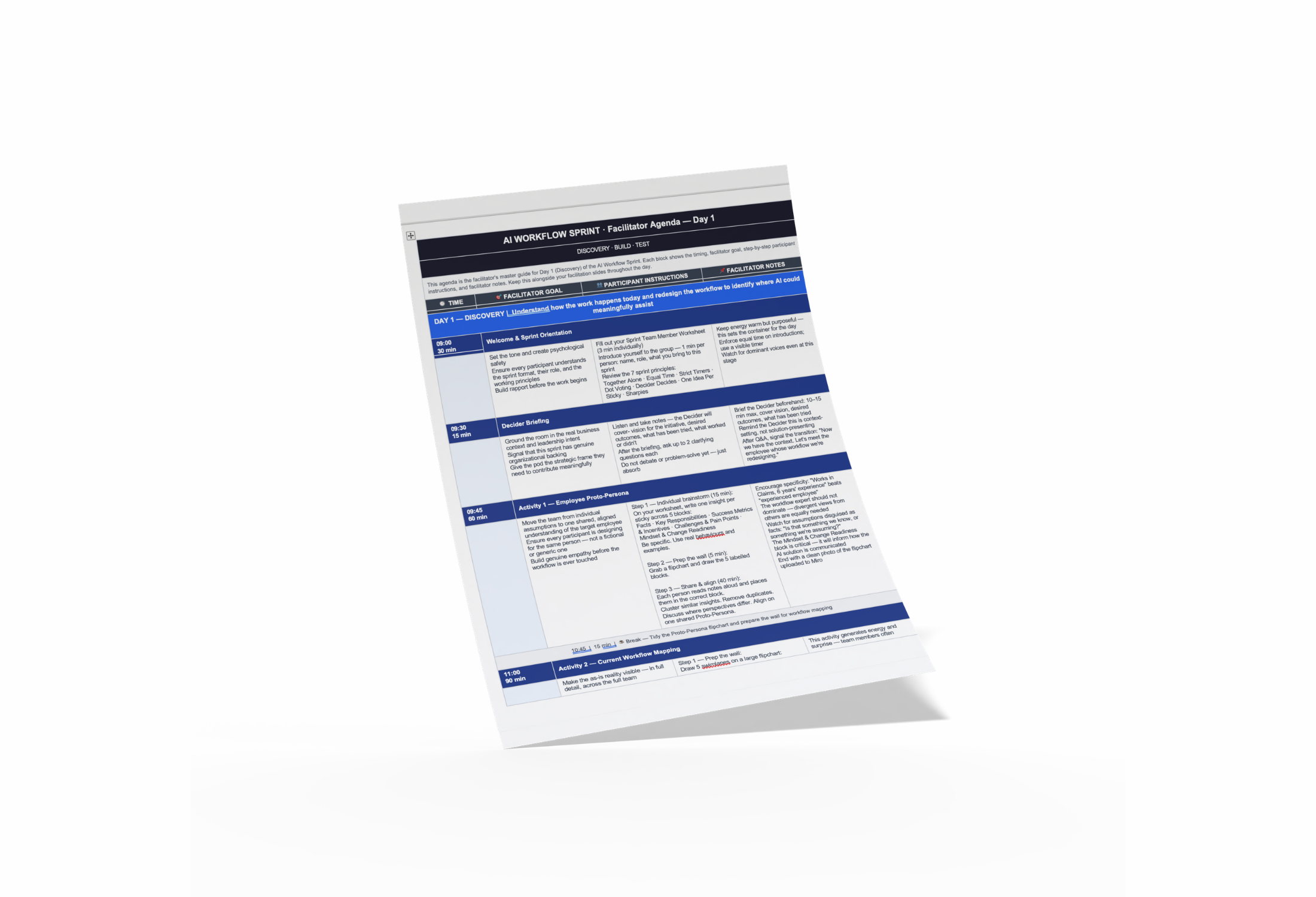
Minute-by-minute agendas for all four days. Every activity mapped to a time block, with buffer built in. Keeps you on schedule when discussions get heated.
.png)
Printable templates for every structured activity — Employee Proto-Persona, Long-Term Goal, Risk Map, Solution Sketching. Distribute at the right moment and the room knows exactly what to do.
If you have any other questions or feedback, please contact us and we'll get back to you shortly.

I've never run an AI Workflow Sprint. Can I use this?
Yes — if you already facilitate structured workshops. The playbook gives you the rationale behind every activity, the slides give you the instructions, and the agendas keep you on time. What you need is facilitation experience. The methodology is provided.
What type of workshop is this — and how does the kit support it?
The AI Workflow Sprint is a four-day facilitated workshop. A cross-functional team works through a single employee workflow — mapping it, redesigning it with AI, building a prototype, and testing it with real employees. The output is a concrete, tested AI solution concept — not a report, not a slide deck. The kit gives the facilitator everything needed to run it: a step-by-step playbook, facilitation slides for all four days, a day-by-day facilitator agenda, participant worksheets and templates, and AI Capability Cards. The facilitator guides the process. The team does the work.
Who is this workshop for?
The workshop is designed for organizations that have a specific AI use case and want to move from idea to tested solution — without committing months of engineering effort first. It works best when leadership is asking for ROI from AI investment, a high-friction workflow has been identified, and business and technical teams need a shared process to make decisions together. The sprint requires a cross-functional team of 6–8 people in the room: a Decider (Product Manager or VP), a Design Lead, an AI/ML Engineer, a Data Engineer, a Business Analyst, a Researcher, and a Workflow Owner. Legal and Compliance are strongly recommended where relevant.
When should you not run this sprint?
Don't run it if: there is no specific workflow problem defined yet; leadership has already committed to a specific solution and isn't open to a test-and-decide outcome; the team in the room is not cross-functional enough (no workflow knowledge, no AI capability, or no Decider); the real issue is organizational or architectural rather than workflow-level; or the data the AI would need doesn't exist, isn't accessible, or isn't permitted by regulation.
Who facilitates — and what do they need to be able to do?
The AI Facilitator guides the process. They are not the technical expert, the workflow owner, or the decision-maker. Their job is to prepare the team, structure the four days, manage pace and participation, and ensure the sprint ends with a clear decision. They need facilitation experience and enough AI fluency to keep the team grounded — not to answer technical questions, but to recognize when the conversation is drifting and redirect it. The playbook is written for this person.
What does the sprint produce?
Four outputs, one per day: a redesigned workflow with waste removed before AI is introduced (Day 1); a solution design — long-term goal, success metrics, storyboard, and build plan (Day 2); a working AI Agent MVP realistic enough for employees to interact with (Day 3); and a sprint decision — scale, iterate, or stop — made by the Decider based on evidence from five real employee interviews (Day 4). The decision is the point. Everything else builds toward it.
I’m a consultant. Can I use this to run paid workshops for my clients?
Yes. Your purchase includes a Commercial Facilitation License. This means you are fully authorized to use these materials (slides, agendas, worksheets) to deliver high-value, paid workshops to your own clients. You can charge for the session, you just cannot resell or distribute the digital files themselves.


