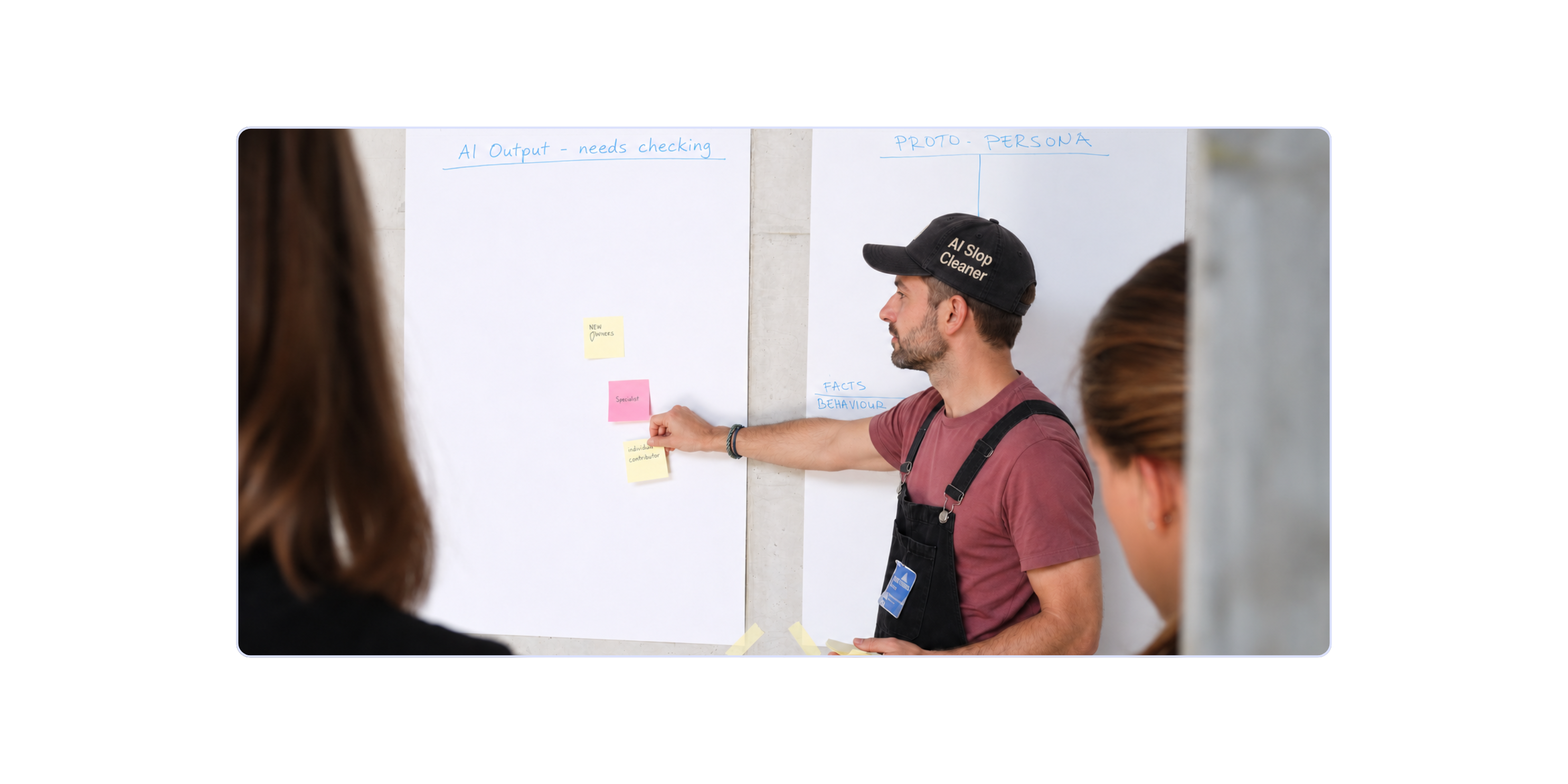
Should you hire an AI Slop Cleaner?

The role you'd never want
What if I suggested you hire an AI Slop Cleaner? You'd probably say, “That's a ridiculous idea.”
You wouldn't want to put that role on your org chart. But what if some of that work is already happening in your organization allready?
Over the past two years, you've given your teams AI tools, licenses and training to help them use those capabilities. As people experimented, AI found its way into more and more of their work. According to Glean's Work AI Index 2026, 87% of desk workers now use AI at work, and 75% say it makes them more productive.
But those gains come at a cost: extra work. It comes in two forms.
Botsitting is babysitting the bot: giving it context, supervising its output and fixing its errors.
Workers report spending 37% of their AI time on this, about 6.4 hours a week. That's more than the 36% they spend producing work with AI.
Botshitting is passing along AI output that people haven't verified, don't fully understand or can't stand behind.
69% of AI users report at least one of these behaviors. 41% have handed over AI-assisted work they couldn't fully explain, and 28% have blamed AI for their own mistakes.
One can feed the other. Keeping up with the bot takes attention. When people are stretched and deadlines are close, checking gets cut short, and a colleague picks up the extra work.
Even without a formal role, this extra work has become part of people's jobs. It's one reason the productivity gains are so hard to see at the organizational level.
Here's the good news. Once you can see and measure the hidden work, you have more choices about what to do with it. Maybe not every process needs AI. Maybe some processes need to change entirely, and some roles need to be redesigned. Maybe you need to invest in people's critical thinking and judgment in less conventional ways.
Knowing that AI adoption brings both gains and losses can shape your strategy from here. You can redesign the work around AI and decide where it gives reliable results and adds value and speed. And you can give people's judgment a clear place in the process, with the time and support it needs.
This piece is for you if you build AI capability in your organization, whether through L&D, an AI academy, an enablement team or a Champions program. You'll leave with a way to investigate and redesign this work, and a system that makes it stick.
Is everyone a part-time AI Slop Cleaner?
For many workers, the answer is yes.
Across the 6,000 desk workers the Index surveyed in the US, UK and Australia, cleanup is a common experience. 77% of workers corrected or redid AI-assisted work in the past month, and 30% do it every week. 60% rerun the same prompt across several tools in search of a usable result. Workers also report that 36% of AI sessions fail and need a restart or substantial rework.
It grows with use. Among light AI users, 20% clean up AI output every week. Among heavy users it's 39%, and 17% do it every day.
People getting strong results do it too. They spend more of their AI time botsitting than those reporting weaker results (40% vs. 33%). 79% of them caught and fixed an AI error in the past month. They check on purpose.
You don't need the AI Slop Cleaner title to find yourself doing the job.
How did we get here?
Part of the answer may lie in how we measure AI adoption.
When organizations started adopting AI, usage and activity were the easiest things to measure. By 2026, almost every Fortune 500 company tracked overall AI usage: tokens, prompt counts, license activations and seat utilization. HRD, citing CNBC
Some organizations went further and started rewarding it:
- Token use as a scoreboard. At Meta, an internal leaderboard called “Claudeonomics” ranked about 85,000 employees by token use before it was taken down. Amazon showed team token statistics on internal leaderboards, and some employees ran low-value tasks through an internal agent tool just to push their numbers up. The practice now has a name: tokenmaxxing.
- Usage targets. Amazon set a goal for more than 80% of its developers to use AI tools every week.
- AI use in performance reviews. In 2025, Shopify’s CEO told staff that AI usage questions would be added to performance and peer reviews. A senior Microsoft executive wrote that using AI is “no longer optional.”
The Work AI Index suggests why this can backfire. More AI isn't automatically better AI. Workers juggling several tools are 35% more likely to botsit frequently, and those running several agents are 1.3 times more likely to botshit. Heavy users are the most likely to botshit: 82%, compared with 50% of light users.
What's missing from the scorecard matters too. Where productivity is the only AI metric, 74% of workers report botshitting behaviors. Where quality is measured as well, the figure drops to 64%.
Management scholar Steven Kerr named this pattern in 1975: rewarding A while hoping for B. We hope for better work, then spend most of our attention counting how much AI people use.
Here’s my point. Some of that AI slop could have been avoided by design. If we measured and rewarded the quality of outputs and good judgment, and not just usage, more of those productivity gains might finally show up at the level of the organization.
AI slop is largely a consequence of measuring and rewarding the wrong things.
The good news is that some companies are already correcting course. In October 2026, Amazon sent engineers a memo pushing back on tokenmaxxing and asking them to be pickier about when they use AI. CNBC
Now what?
If usage is the wrong target, what's the right one?
Better decisions about when and how to use AI.
That means deciding, before anyone rolls out a tool, which work AI should take on, which work it should only support, and which work it should stay out of. It also means agreeing up front on what good output looks like, who checks it, who owns it, and how it moves across workflows, teams, departments and business units.
AI high performers make these decisions deliberately, and they're still rare: only about 6% of the organizations in McKinsey's 2026 State of AI survey. So what do they do differently? Nearly three-quarters of them have fundamentally redesigned workflows because of AI, compared with about one in four of everyone else. They're also twice as likely to have defined processes for measuring AI's impact.
The Work AI Index sees the same pattern. Its most transformative organizations mapped drudgery, customer friction and handoff failures first. They picked tools after.
These findings support taking workflow redesign seriously. The practical lesson is to start with a clear problem, a business goal and measures that matter.
Redesign the work first, so there's less avoidable work to clean up.
We have a system for this: the AI Lab
You can follow the same approach as AI high performers.
Start with a strategic goal and map how the work happens today. Bring your subject-matter experts together with your AI engineering and data teams to explore where AI could help and how the workflow would need to change. Discuss the risks and constraints early, while the team can still shape the approach.
Making one good decision this way takes a workshop. Making good decisions every time, across teams and business units, takes a system. At Design Sprint Academy, we call that system the AI Lab.
An AI Lab runs alongside your core business. It's a cadence of workshops that answers one question before you commit serious money, time and people: when and how should we use AI, and where is it worth the investment?
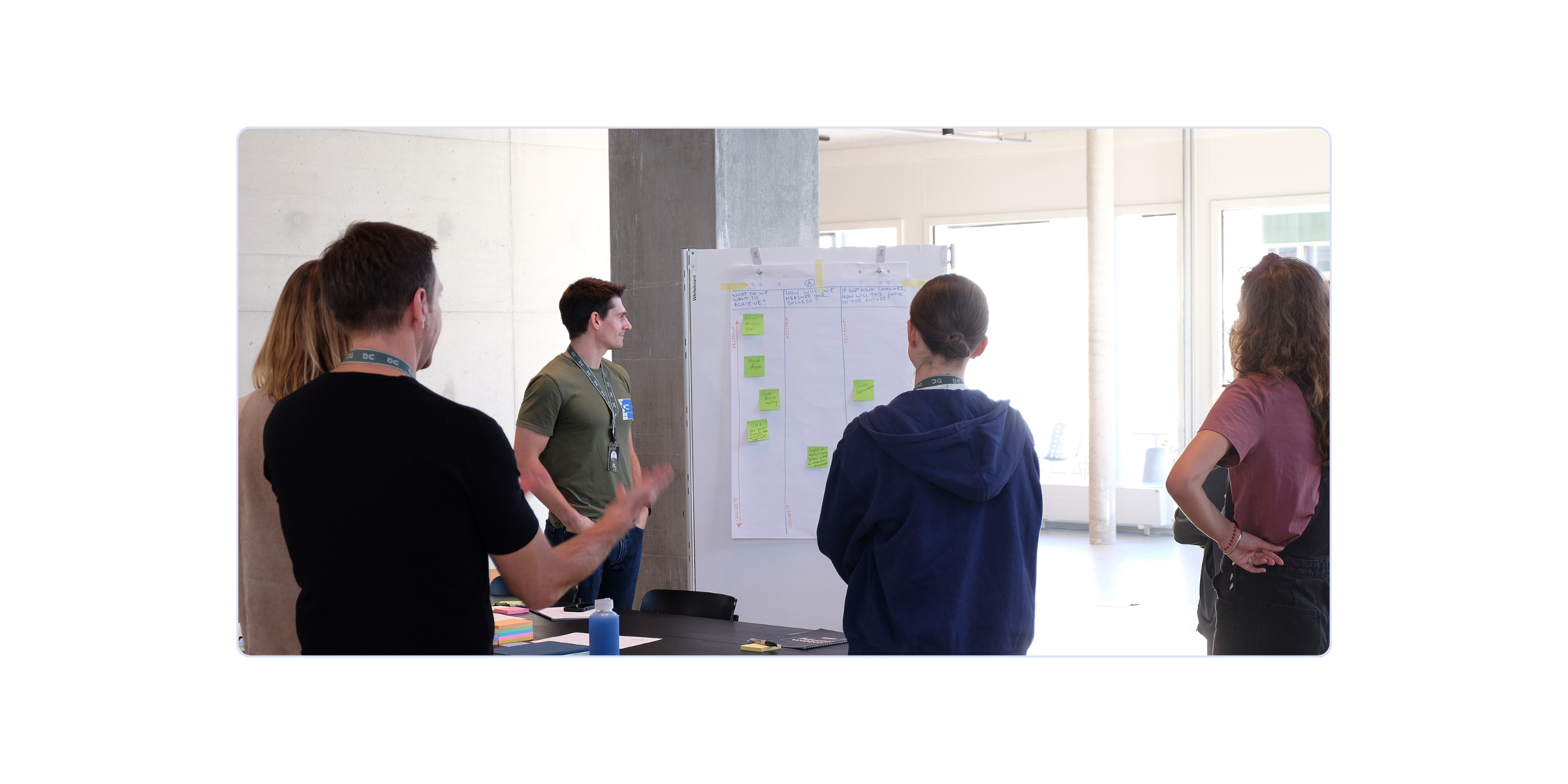
Each Lab brings together a small, temporary team of business leaders, SMEs and technical experts from AI engineering and data, which we call an AI Discovery Pod. Internal AI Facilitators guide the work. Each workshop feeds into the next, and each ends with a clear decision and a rationale the team can stand behind.
Here's how a Lab runs.
Step 1: AI Problem Framing
Every Lab starts here. The Discovery Pod sits down together and tests AI opportunities against the strategic goals. They map how the work happens today and assess what AI can reliably do.
Some ideas will be worth exploring further. Others can be set aside, giving the team more time for the opportunities that matter.
This also helps the team see where it makes sense to leave the work with people. Before any tool touches the work, the team decides where a person must still understand it, judge it and own it.
Step 2: Redesign and test the work
The opportunities the team chooses to explore move into a deeper workshop. Which one depends on who the solution is for.
Internal workflows go into an AI Workflow Sprint. This is where many AI pilots fall short. AI makes one task faster, and the workflow around it barely moves. A proposal that took a day to draft now takes minutes, then sits in a review queue, because the people checking figures and approving terms still work the way they did before. The bottleneck didn't disappear. It moved.
The AI Workflow Sprint is built for that problem. Over four days, the Discovery Pod maps how the work actually happens today, which is often different from what the official process says. Then it redesigns the whole flow around what people and AI should each own. A small build team turns that design into a working AI agent prototype, and the team tests it with five employees who do the work every day.
Customer-facing problems go into an AI Design Sprint. Over two to four days, the team explores solution options, prototypes one direction and tests it with real users. It ends with a user-tested concept and a clear picture of what to build.
Before testing, the team agrees on the quality required. After testing, it compares the total effort with the current process, including review time and work passed to the next person. Both sprints then end with a decision based on that evidence: go ahead, change the approach or stop.
Step 3: Make it repeatable
One Lab redesigns one workflow. The real value comes from making these checks standard for every AI initiative. That's why the Lab runs on a steady cadence, led by internal AI Facilitators. They could be your trained AI Champions, AI transformation leads or AI coaches. Their job is to get the right people in the room, harness their collective intelligence and keep decisions moving.
Every time, the team looks at the handoffs and asks where the next bottleneck could appear, then redesigns before it forms. Every time, an AI agent earns its autonomy only when testing shows it is reliable enough. That's how cleanup gets designed out of the work before it ever reaches the next person.
Less cleanup is a design decision.
The cadence also broadens what you count. It tracks how many ideas were framed, how many were set aside early and how many moved to production. Then it follows those decisions through to business results: quality, total effort and downstream rework. Token use, tools launched and ideas set aside can help you understand cost and activity. Their value becomes clearer when you connect them to what improved.
Where to start
You don't need to redesign everything at once. Start with one Lab: one workflow, one business owner who cares about the result.
An internal AI Facilitator brings the Discovery Pod together and guides it through the process. They help the group surface assumptions, weigh the evidence and work through trade-offs. The decisions stay with the people accountable for the work.
If you build AI capability in your organization, helping people facilitate these conversations is a practical place to start. Give them the methods, practice and support to help teams make informed choices about where AI belongs.
And bring in the people already doing the cleanup. They can show you where the extra work lands and what keeps causing it. That's a useful starting point for your first Lab.