The AI Champion role is evolving from adoption to transformation
AI Champion programs were built to help organizations move from experimentation to adoption. As leadership starts asking for measurable business impact, the role — and the system around it — needs to evolve.
For many organizations, the first AI Champion program solved a very practical problem.
People had access to new AI tools, but they did not always know where to begin. Teams needed practical examples. Employees needed trusted colleagues who could help them apply AI to real work. Central AI teams could not support everyone directly.
So organizations began bringing people who were already experimenting with AI and trusted by their teams into Champion programs, giving them a more formal role in helping adoption spread locally.
Once inside the program, their job was practical: make AI easier to apply in real work, share what was working, and surface where teams were getting stuck.
That model still works.
But the expectations around AI are changing.
Leadership is increasingly asking a different set of questions:
- Where is AI actually delivering measurable business impact — time saved, cost reduced, revenue protected or grown, quality improved, risk mitigated, or capacity unlocked?
- Which workflows and use cases are producing repeatable value — and which are still experiments or activity?
- How do we connect AI adoption to P&L outcomes, KPIs, and strategic priorities rather than just tool usage or training completion?
- What should we scale, stop, or redesign based on evidence of results?
- How do we move from scattered pilots and individual experimentation to systematic, organization-wide capability with clear accountability and governance?
- Are teams changing how work actually gets done — behavior and process change — or are we mostly seeing surface-level adoption?
- What is the ROI of our AI investments and of the enablement systems, including Champions, that support them?
The Champion role that was designed to support adoption is now being pulled toward a much broader transformation mandate. That creates a design question for every organization running an AI Champion program:
Is the role — and the system around it — designed for what we now expect Champions to deliver?
The Champion role started with adoption. Now the mandate is expanding.
Early Champion programs were designed to help AI take root inside teams.
OpenAI describes these local Champions as Activators: people close to the work who help colleagues adopt validated workflows, adapt examples to their context, share what works, and surface blockers back to the organization. Their role is deliberately lightweight, and they are not expected to own the entire adoption system.
That model makes sense when the main challenge is adoption.
But as leadership starts asking for measurable business impact, workflow change, prioritization, governance, and scale, the work around Champions becomes broader.
OpenAI's updated model now distinguishes another role under the same AI Champion umbrella: Leaders. Leaders operate across teams and functions, connecting AI work to business priorities, coordinating stakeholders, securing resources, defining success, and removing blockers that local teams cannot resolve alone.
That coordination is also human work. Leaders often need to bring business, IT, security, data, operations, and other stakeholders into the same conversation — helping them build a shared understanding of the problem, work through trade-offs, and move toward decisions.
So the Champion model is becoming more differentiated:
Activators help AI take root locally. Leaders help turn that local progress into coordinated organizational change.
And as the ambition moves from adoption toward transformation, organizations increasingly need both.
Role clarity helps. But it does not close the capability gap.
Distinguishing between Activators and Leaders creates useful clarity.
It prevents one broad “Champion” role from becoming responsible for everything. Activators can stay close to teams and workflows, while Leaders provide direction, sponsorship, coordination, and access to decisions.
That connection matters. Activators need a route for surfacing promising opportunities and blockers. Leaders need signal from the teams doing the work. And good ideas need a path into resources, governance, implementation, and scale.
But many organizations will still have a gap in the middle.
A local Activator may spot an opportunity that is bigger than peer adoption, but not yet mature enough to become a formal transformation initiative. Someone has to help turn that early signal into something the organization can act on.
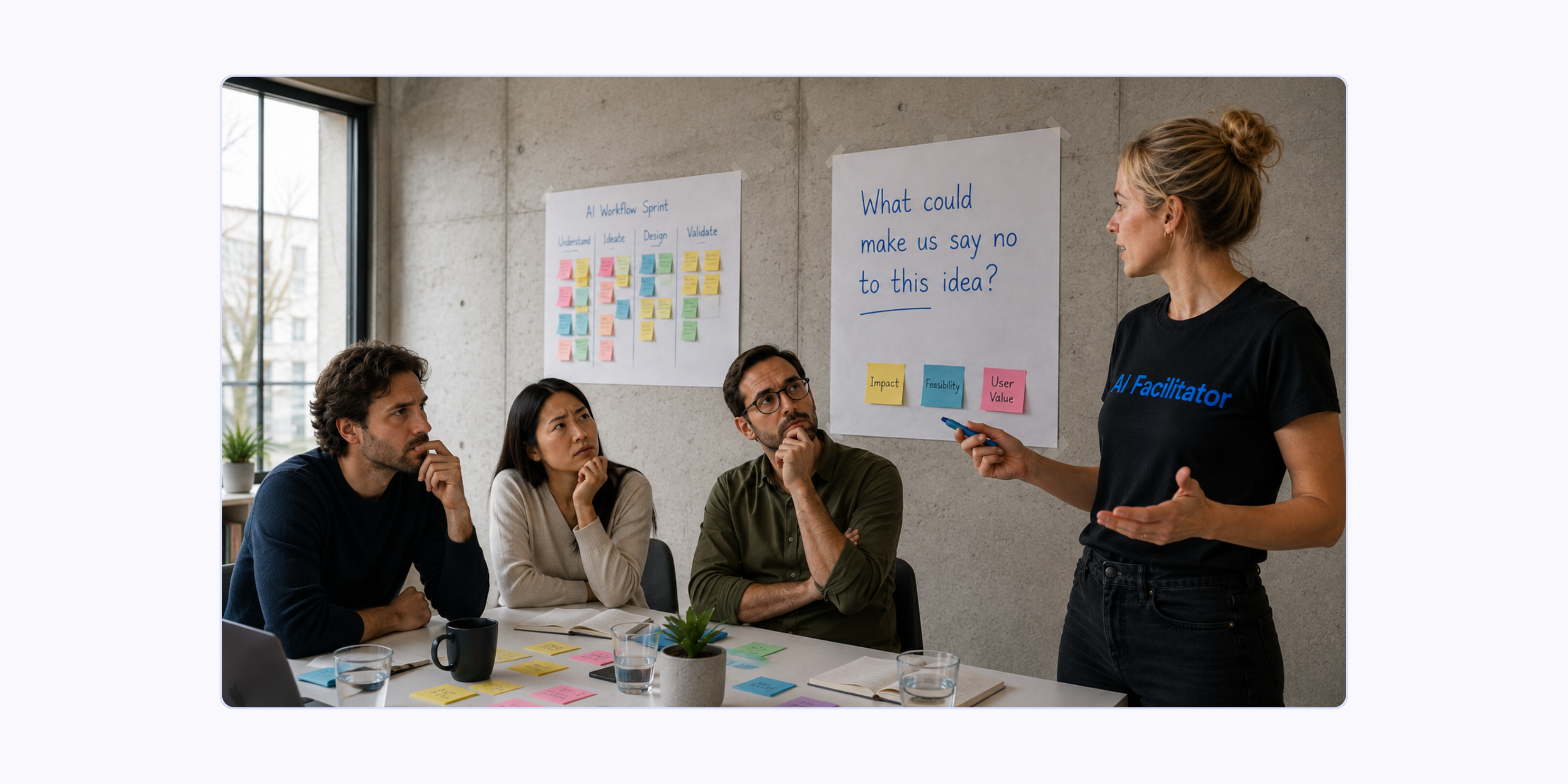
That work can include framing the business problem, understanding the current workflow, bringing the right functions into the room, facilitating the conversation, working through assumptions and trade-offs, connecting the opportunity to business outcomes, and preparing a clear recommendation or handoff.
In some organizations, a Leader or central transformation team will do that work.
In others, selected Champions will increasingly be expected to take on part of it themselves.
That creates two complementary moves for Champion programs: connect Activators and Leaders more deliberately, and redesign selected Champion roles where the mandate has expanded.
If Champions are expected to move beyond local adoption and help shape opportunities for transformation, the role needs more than a stronger reporting line. It needs the skills, shared methods, time, decision paths, and operating conditions to do that work well.
Redesigning the Champion role for transformation
This does not mean turning every AI Champion into a strategist, product manager, facilitator, or transformation lead.
It means being deliberate about which Champions are expected to do more — and designing those roles accordingly.
Three areas matter.
1. Build the capabilities the new mandate requires
A Champion supporting local adoption needs different capabilities from someone expected to help move an AI opportunity from idea to decision.
Selected Champions may need to learn how to:
- identify and prioritize AI opportunities
- start with business and workflow problems rather than AI features
- map how work happens today
- redesign workflows around AI
- distinguish what AI should automate, assist, or augment
- facilitate cross-functional working sessions so business, IT, security, data, and operations can frame the problem, surface assumptions, work through trade-offs, and reach decisions
- connect AI opportunities to business outcomes
- surface risks, constraints, and dependencies
- define what success should look like
- prepare an opportunity for a clear decision or handoff
These are learnable skills.
But they need to be developed intentionally if organizations expect Champions to use them.
2. Give Champions shared methods, not just knowledge
Strong Champions should not have to invent their approach every time a team brings them an AI idea.
A shared method creates consistency.
It gives people a repeatable sequence for moving from a vague request such as "Can we use AI here?" toward a clearer decision.
That might include a common way to:
- understand the business objective
- identify the employee or customer affected
- map the current workflow
- surface friction and value opportunities
- identify where AI could meaningfully help
- assess feasibility, data, risk, and adoption constraints
- redesign the workflow
- define success measures
- decide what should move forward
The method does not replace judgment.
It gives Champions a common structure for applying it.
It also makes the program easier to scale because teams are no longer dependent on whichever approach an individual Champion happens to prefer.
3. Build the operating structure around the role
Skills and methods will not create transformation if the surrounding system still makes the work impossible.
Champions also need clear operating conditions.
This is what turns Champion capability into organizational capability.
.png)
A useful place to start: look at the gap
Not every Champion program needs a redesign. But if the mandate has expanded, it is worth checking whether the conditions around the role have expanded with it.
Look at three things together: what Champions are expected to do, where their time actually goes, and what support they have around them — skills, methods, decision paths, sponsorship, ownership, and measurement.
That comparison usually makes the next conversation much clearer.
The AI Champion Program Scan was built for exactly that. It gives you a simple view of where the role and the program are aligned, where the setup may be under strain, and which conditions are worth looking at first.
.png)