Which workflows can an AI Champion take on alone, and which need co-design?

Everyone has a workflow they think AI could fix.
The interview slots you still have to coordinate across calendars. The candidate notes you turn into a consistent interview summary. The weekly hiring update assembled from recruiter notes, interviewer feedback and open roles.
It makes sense that you'd want to hand this work over. And in many organizations, AI Champions are already the people colleagues turn to for help.
But there's a problem hidden inside that request.
"Can AI improve this workflow?" can mean anything from helping one recruiter schedule interviews faster to redesigning the hiring process across recruiting, hiring managers, interviewers and HR — changing how candidates move through stages, who evaluates what, how feedback is combined, who makes the hiring decision and who approves the offer. Those aren't the same kind of change, and they shouldn't be handed to a champion in the same way.
In the first wave of AI adoption, many AI Champions were asked to help colleagues learn how to use the tools by improving the work already in front of them: coordinate interview scheduling faster, summarize interview notes, draft candidate communications or automate a few repetitive recruiting steps.
Now the expectation is shifting. Leadership wants to see efficiency gains, measurable business impact and a return on the investment in AI capability.
That raises the bar considerably. Knowing how to improve a task with AI doesn't automatically mean someone knows how to redesign the workflow around it. They may not have the authority to change how other teams work, the expertise to judge every part of the process, or the mandate to resolve ownership, risk and decision-making across functions.
Before you ask a champion to redesign a workflow, you need to understand what you're actually asking them to change.
First: define your ambition
If your ambition is to help employees take repetitive work off their plates, small individual improvements make sense. A champion might help a recruiter reduce the admin around interview scheduling, summarize interviewer notes faster or remove repetitive steps from candidate communications they already own.
But if you expect substantial productivity gains, lower costs or measurable ROI, that is a different ambition.
The evidence so far suggests that today's largely individual use of generative AI is producing modest time savings at workforce level. In Q2 2026, the St. Louis Fed's Real-Time Population Survey estimated the time saved at 2.2% of total work hours across employed U.S. adults — roughly one hour in a 40-hour week.
That doesn't mean an individual workflow can't create significant value. But as you try to scale a successful redesign across a team or function, the change stops being one person's decision. Standards, quality checks, responsibilities and downstream work start to matter. Bigger ambition therefore tends to pull you toward shared workflow redesign, either because the workflow already crosses roles or because scaling the change makes it shared.
So define the ambition before you define the champion's job.
Are you asking champions to help employees improve the work they control? Or are you asking them to help teams redesign shared work for larger business impact? Both matter. They require different support, authority and skills.
Second: understand the different types of work
When people say "workflow," they often mean very different things. Before you decide what a champion can take on, you need a practical way to distinguish the work itself.
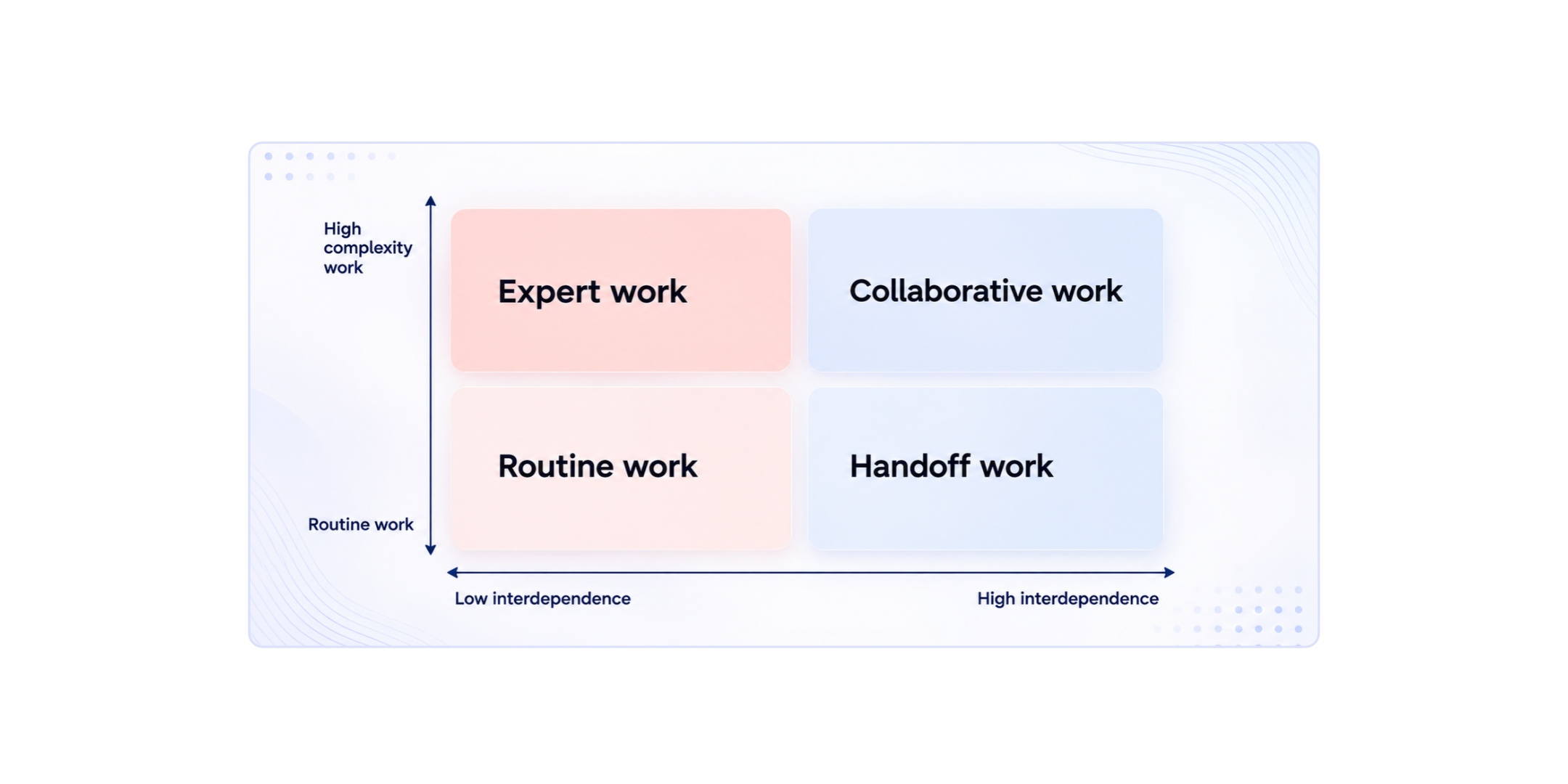
Thomas H. Davenport's Thinking for a Living (2005) offers a useful starting point. Davenport classifies knowledge work using two dimensions: the complexity of the work, from routine to interpretation and judgment, and its level of interdependence, from individual actors to collaborative groups.
For AI workflow redesign, those dimensions give you two useful questions: how much judgment does the work require, and how many people does it depend on?
How much judgment is involved? Some work follows clear rules: collect the information, put it in the right format, complete the known steps. Other work depends on interpretation: deciding what matters, what looks unusual, or what should happen next. The more interpretation the work requires, the more important it is that the person doing it has the expertise to know what good looks like and make the right call.
Take a recruiting team. Scheduling an interview once you have the candidate's availability, the interviewers' calendars and a standard interview plan is relatively low-judgment work. The constraints are known, and you can check whether the right people are booked for the right stages. Deciding whether a candidate should move forward after mixed interview feedback is different. That decision depends on the requirements of the role, the evidence gathered in the interviews, the trade-offs the team is willing to make and the hiring manager's judgment about what good looks like.
How many people does the work depend on? Some work can be completed by one person from start to finish. Other work moves between several roles, with people providing information, reviewing it, approving it or making connected decisions. The more the work depends on those handoffs and decisions, the more likely your redesign will need those people involved.
Again, take recruiting. If a recruiter can review an application against agreed criteria, record a screening note and decide whether to invite the candidate to an initial recruiter call, the work is largely independent. But move further into the hiring process and the outcome starts to depend on several roles: the recruiter coordinates the process, interviewers assess different areas, the hiring manager weighs the evidence and HR may need to approve the offer. Improving only one person's part may save time, but redesigning the workflow means looking at the handoffs, criteria and decisions between everyone involved.
Put those questions together and you get four useful descriptions of work.
.png)
This isn't about putting the whole workflow neatly into one box. Most workflows contain a mix of all four types of work. What matters is understanding where most of the work sits.
Is the workflow mostly routine work one person can complete, with a few moments that require expert judgment? Or does most of the outcome depend on several people handing work between them, interpreting information and making connected decisions?
You don't need an exact percentage. But knowing whether the work is predominantly individual or shared, routine or judgment-heavy gives you a much better sense of what kind of redesign you're dealing with — and where you may need to involve more people.
Third: decide who needs to be involved
Once you know where most of the work sits, the matrix starts to tell you what to expect.
The matrix tells you about the work; the change you're proposing tells you who needs to be involved. A workflow may depend on several roles without every improvement affecting all of them.
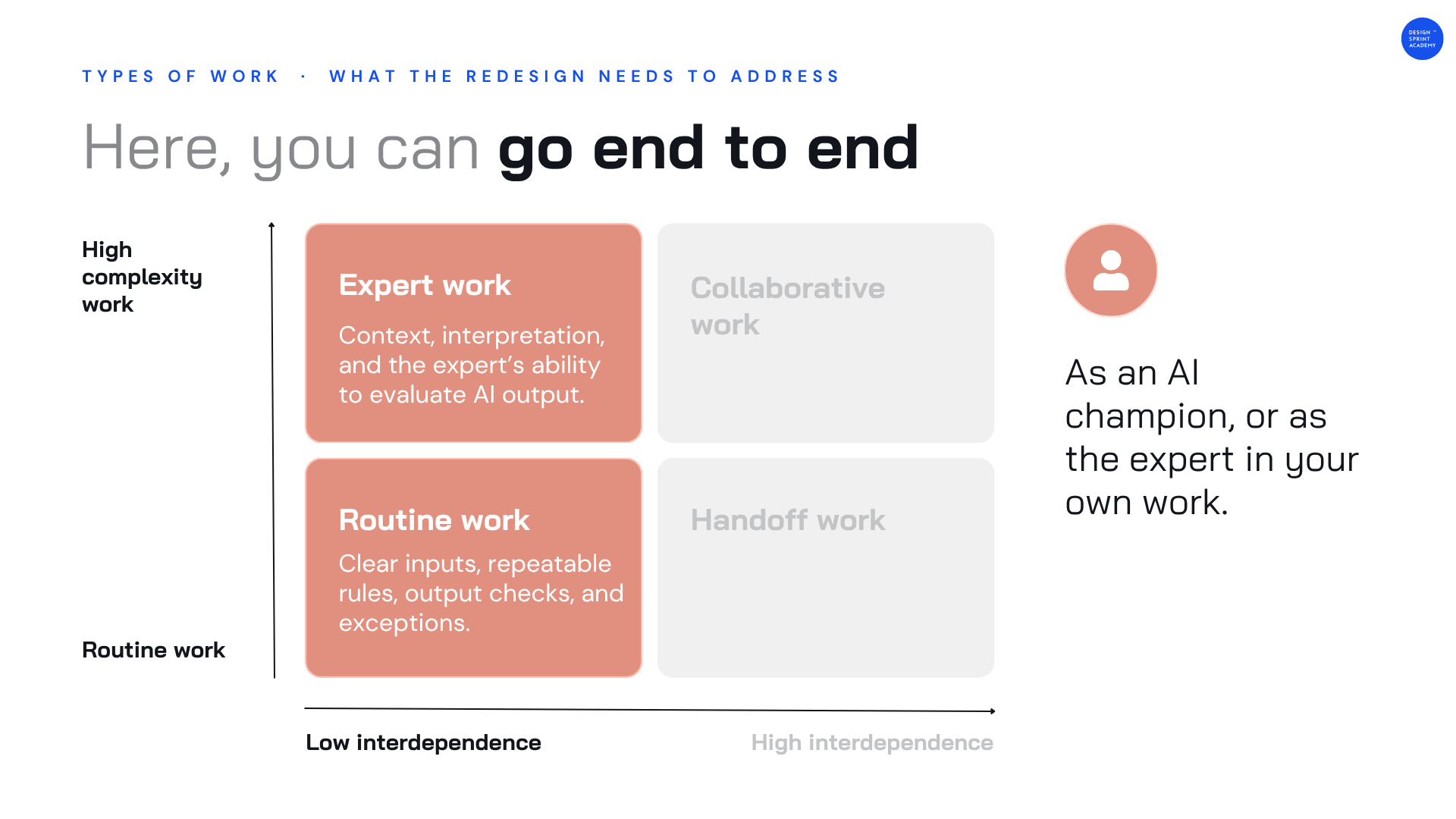
On the left side, the work is largely controlled by one person.
Routine work is the clearest case. The steps are known, the inputs and outputs can usually be checked, and the person doing the work can tell you where the friction is. A champion can work with that person to map the process, identify where AI could help, and test whether a redesigned workflow produces the same or better quality with less effort or time. Because the rules are relatively clear, you can usually evaluate the change without involving a larger group.
Expert work is less predictable. The steps can vary, the inputs and outputs may change from case to case, and edge cases often matter more. The key question is whether the person who owns the work has enough expertise to judge the AI's output and decide when it should or shouldn't be trusted. If they do, an AI Champion can still work with them directly.
Here, the champion doesn't need to be the domain expert. Their job is to ask the workflow owner the right questions, make the AI's capabilities and limitations clear, and help design a test that exposes where the new workflow works and where it breaks.
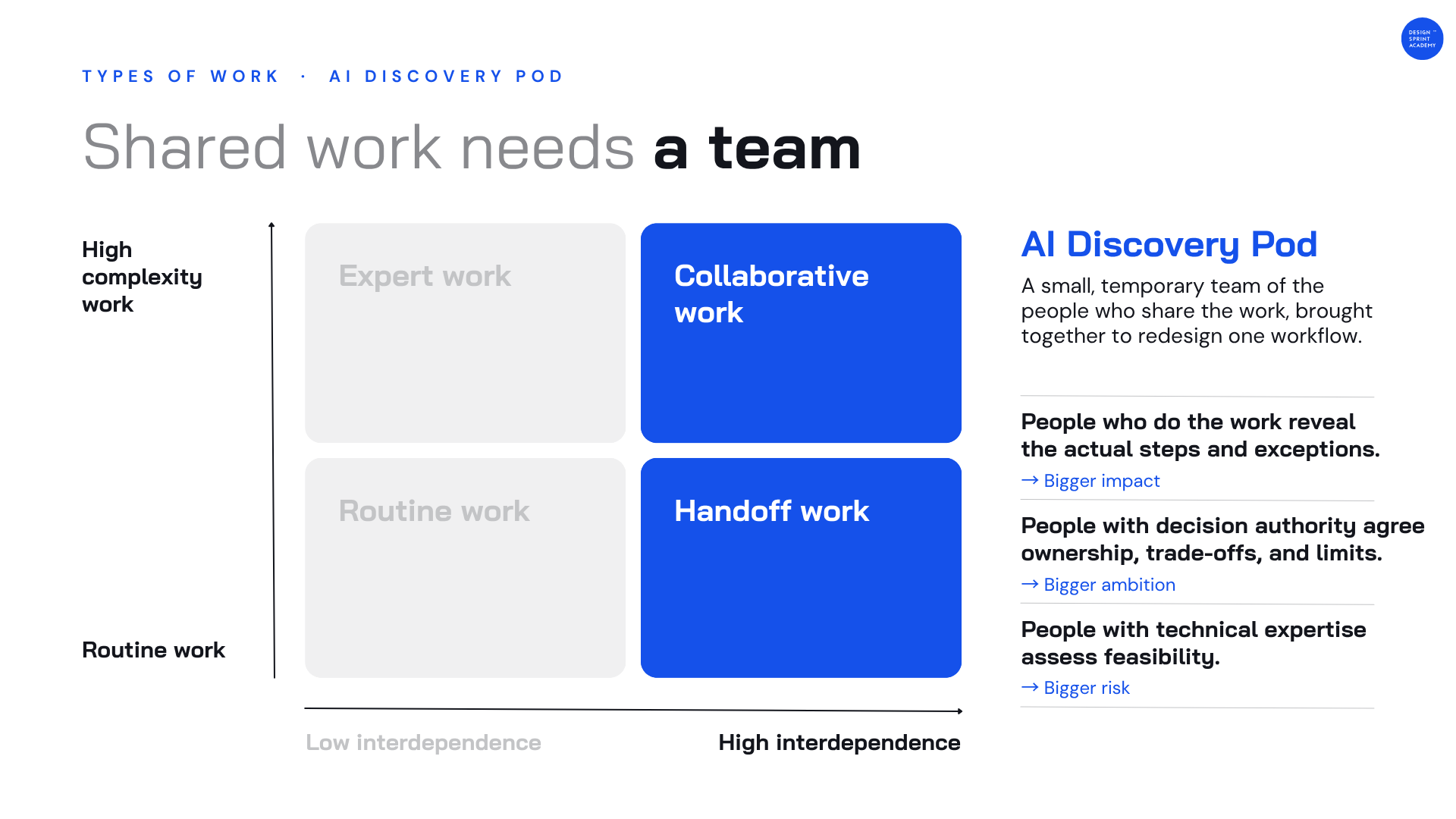
The right side is different.
With handoff and collaborative work, no single person controls the whole workflow. The result depends on what several people provide, check, approve or decide. If you change one part, you may also change what someone else receives, what they're responsible for, or the decision they're expected to make.
That means you're no longer only improving one person's way of working. You're changing agreements between people.
With handoff work, those agreements are often about inputs, acceptance criteria, ownership and exceptions. With collaborative work, they can also involve interpretation, competing priorities and shared decisions. In both cases, redesigning the workflow means involving the people who own those parts of the work, not just informing them after the fact.
That changes the nature of the redesign.
The potential impact can be larger because more of the workflow is affected. The scope of the change is larger because you're changing how work moves across roles, and sometimes the roles themselves. And the risk is larger because a poor decision or badly designed handoff can travel further before someone catches it — and can be much harder to reverse once other people have adapted their work around it.
This is where interdependencies matter. Once changing one part of the workflow changes what other people need to provide, check, decide or approve, the redesign no longer sits with one person. The knowledge and authority needed to change it are spread across the workflow.
When that happens, a champion has two ways to proceed.
The first is sequential. The champion gathers perspectives one at a time: interviewing the people involved, reviewing tools and documentation, perhaps using surveys, and then developing options for how an AI-enabled workflow could work. After that comes another round of conversations to collect feedback and reconcile the differences.
This can work, but it creates a coordination problem of its own. Each person sees a different part of the workflow. Disagreements surface late. What one process owner accepts, another may reject. The champion ends up carrying assumptions and feedback back and forth between people who are not making the trade-offs together.
I've seen technically strong AI teams, including people with PhDs, get stuck here. They struggled to reconcile what the experts at different handoffs actually needed, or to get agreement on what a good output should look like.
For that reason, I wouldn't make this sequential path the default for shared workflow redesign.
The second is co-design. Instead of collecting perspectives one at a time, you bring the critical people together temporarily to redesign the workflow as a shared system. The advantage isn't simply speed. Dependencies, disagreements and trade-offs become visible in the same conversation, with the people who understand them and can resolve them present.
When the work reaches this point, you need a small, temporary group that collectively has the knowledge and authority to redesign it. At Design Sprint Academy, this is called an AI Discovery Pod: typically six to eight people, sized around the workflow and selected for what they know, what they do in it and what they can decide.
You need people who do the work, people who can agree changes to it, and people who understand the technology and data. Other expertise can come in where it's needed.
The pod also needs a Decider: someone who owns the outcome and can commit resources or secure the necessary approval. This is the person who can turn the redesign from an interesting exercise into a change the organization can actually pursue.
The pod is intentionally temporary. It forms around one workflow, works together for two days, and then disbands. Those two days are the co-design part of the four-day AI Workflow Sprint.
On Day 1, the pod makes the work visible. They start with the person doing the job, map how the workflow actually happens across roles, and surface the friction, bottlenecks and breakdowns that each person sees from their part of the process. Then they redesign the workflow together: where AI should assist, augment or automate, and what should stay with the human.
On Day 2, they turn that redesigned workflow into something specific enough to build. They agree the goal, the measures that will tell them whether the change worked, the risks that need to be managed, and what the solution actually needs to do. They finish with a storyboard that shows how the new experience should work end to end.
By then, the full pod has done the part that requires everyone in the room: agreeing how the work should change. The next two days of the sprint don't require all six to eight people. A smaller build team turns the storyboard into an AI agent MVP, and the proposed experience is then tested with employees to generate evidence for what to pursue, change or stop.
For co-design to work, you also need facilitation.
Putting smart people in a room doesn't automatically make them a team. They still arrive with different priorities, different assumptions and different views of what a good outcome looks like. Those differences are useful, but only if the group can surface them and work through them rather than carrying them back into separate conversations afterward.
That's what facilitation is for: designing and guiding the group toward a shared decision and outcome. Someone needs to help the pod make the workflow visible, give the different perspectives room to surface, identify the disagreements that actually matter and turn them into decisions.
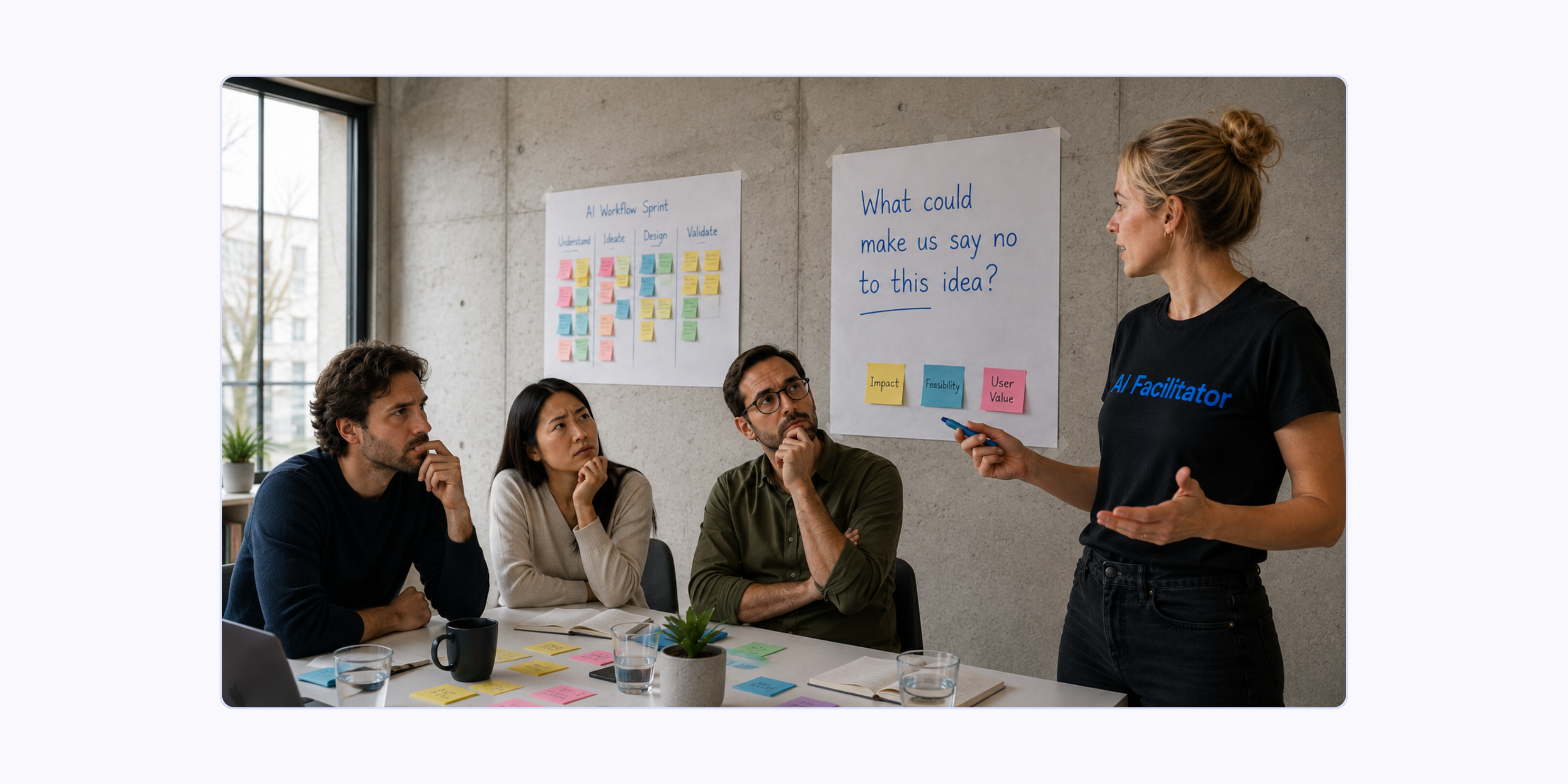
At Design Sprint Academy, we call this role the AI Facilitator. Facilitation is a skill, not something that comes automatically with confidence in AI tools. If you expect your AI Champions to tackle workflows on the right side of the matrix, some of them may need to learn it. That can mean training, practice, a clear structure to follow or an experienced facilitator alongside them while they build the skill.
Conclusion
If you're running an AI Champion program, start with what you expect it to achieve. If the goal is to help employees save time on work they already control, individual workflow improvements can be enough. If the goal is broader business impact through efficiency and productivity, your champions will eventually encounter shared workflows, or successful individual improvements that need to be scaled across a team.
That's where understanding the type of work and the scope of the change matters. Routine or expert work can often be improved with the person who owns it. Handoff and collaborative work make it more likely that a redesign will affect several roles. When the change alters what those people provide, decide, approve or own, one champion cannot redesign it alone.
At that point, workflow redesign becomes a co-creation process. Bringing the right people into the same room makes the dependencies visible and allows disagreements to be resolved while the workflow is being redesigned, rather than through repeated rounds of interviews and feedback.
So if you want your Champion program to move beyond task-level adoption, give champions more than AI skills. Teach them how to recognize the kind of work they're dealing with, judge the scope of the change, know when to involve others, and facilitate a cross-functional group through the redesign.
.png)